
How Small Businesses Can Use AI Web Search to Make Better Business Decisions
Jul 28, 2026
18 min read
Want a Custom AI Consultation?
Experience how BizClearAI can transform your business with immediate, actionable insights and AI-powered consulting.
Small business owners make dozens of decisions every week.
Should you raise prices? Is a competitor offering something you are not? Are customers searching for a new service? Has a regulation changed? Is a supplier’s quote reasonable? Which marketing channel deserves your limited budget?
The problem is not always a lack of information. More often, the problem is finding reliable, current information quickly—and turning it into a decision you can act on.
AI web search can help.
Direct answer: How can small businesses use AI web search?
Small businesses can use AI web search to gather current information, compare competitors, research pricing, track customer trends, review regulations, and evaluate vendors. The best results come from giving the AI clear business context, asking focused questions, checking the original sources, and using the findings to support—not replace—business judgment.
What is AI web search for small business?
AI web search for small business is the use of an AI assistant that can search current online sources, summarize relevant findings, compare information, and organize the results around a business question.
A traditional search engine usually gives you a list of links. You then have to open each result, decide what matters, compare conflicting information, and create your own conclusion.
An AI web search tool can help with the middle of that process. It may:
Search multiple sources
Summarize the most relevant information
Compare options in a consistent format
Identify patterns or disagreements
Provide links or citations for verification
Turn research into a checklist, recommendation, or action plan
That distinction matters because small business owners rarely need more links. They need a clearer answer.
AI web search is especially useful when the information may have changed recently. Examples include local pricing, competitor services, industry trends, laws, software features, vendor terms, consumer behavior, and economic conditions.
It is less useful when the decision depends mostly on information inside your own business, such as employee performance, customer profitability, actual cash flow, or operational bottlenecks. In those cases, online research may help provide context, but your internal data should carry more weight.
AI web search versus regular Google search
Regular search and AI web search are not opposites. They serve different purposes.
A traditional search engine is often better when you:
Know the exact website or document you need
Want to browse many possible sources
Need to inspect original pages yourself
Are looking for a specific business, product, form, or government page
AI web search can be more useful when you:
Need a summary of several sources
Want to compare businesses, prices, tools, or policies
Have a broad question that needs to be narrowed
Want findings organized around a decision
Need an action plan after the research is complete
For example, searching “average plumbing prices near me” may give a plumber dozens of directories, advertisements, forums, and national estimates.
A stronger AI web search request would be:
Compare publicly listed plumbing service-call fees and common repair price ranges for residential plumbers within 30 miles of Tampa, Florida. Separate direct competitor pricing from national estimates, identify the date of each source, and explain what information is reliable enough to use in a pricing review.
The second request does not simply ask for information. It gives the research a purpose.
When AI web search is most useful
AI web search is most valuable when a decision depends on outside information that is current, scattered, or difficult to compare.
1. Competitor research
You can use web search to review:
Competitor services
Public pricing
Guarantees
Financing offers
Service areas
Customer reviews
Promotions
Booking processes
Website messaging
Frequently mentioned customer complaints
This does not mean copying competitors. The goal is to understand the choices customers see when comparing your business with others.
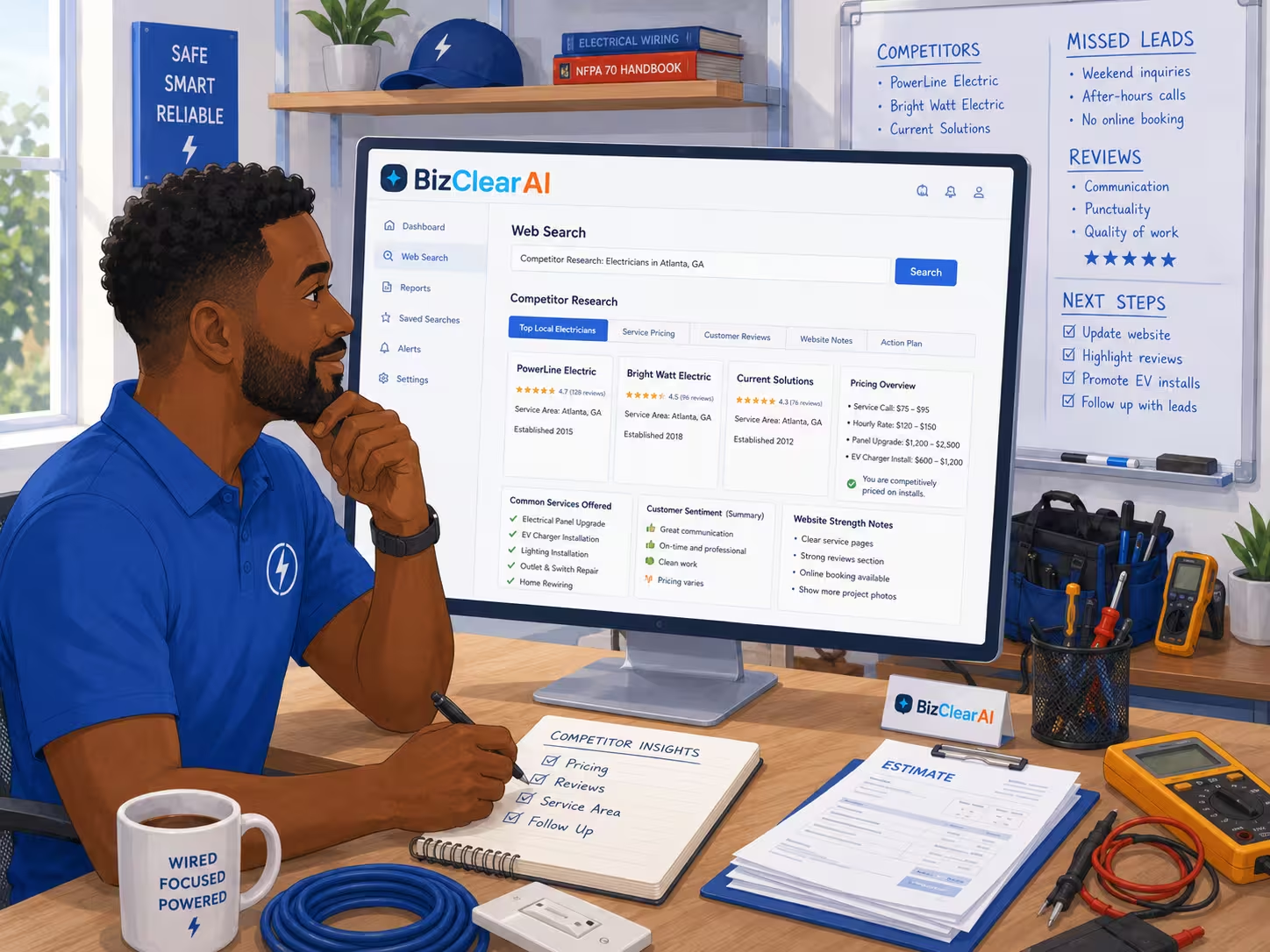
A local contractor, for example, could ask an AI search tool to compare the websites of five nearby competitors. The results might show that most offer financing, three promote same-week estimates, and none clearly explain their warranty.
That may reveal a practical opportunity: make the warranty easier to understand rather than matching every competitor promotion.
2. Pricing decisions
AI web search can help you collect external pricing signals such as:
Competitor price ranges
Industry benchmarks
Supplier cost changes
Local wage rates
Material costs
Typical service fees
Customer expectations
Broader inflation trends
External pricing research should not determine your final price on its own. Your pricing still needs to cover labor, materials, overhead, taxes, risk, and profit.
However, current market information can help you recognize when your pricing is far below, far above, or structured differently from the market.
3. Vendor and software comparisons
Choosing a new payroll system, scheduling platform, payment processor, supplier, or marketing service can take hours.
AI web search can organize the comparison around the issues that actually matter to your business:
Monthly cost
Setup fees
Contract length
Cancellation terms
Integrations
Customer support
User limits
Processing fees
Review patterns
Features for your industry
The key is to define your requirements before searching. Otherwise, the AI may simply summarize which vendor has the longest feature list.
4. Local market research
A business considering a new service, location, or customer segment can use current web information to study:
Population changes
Local income levels
Business openings and closures
Building permits
Tourism activity
Major employers
Search demand
Competitor density
Local development projects
Government and university sources are often useful for this kind of research. Depending on the question, relevant sources may include the U.S. Census Bureau, Bureau of Labor Statistics, local government records, state licensing agencies, and Small Business Development Centers.
5. Regulations and compliance
AI web search can help locate information about:
Licensing requirements
Permit rules
Employment regulations
Tax deadlines
Industry standards
Local ordinances
Required notices
Filing requirements
This is an area where source quality is critical. An AI-generated summary should not be treated as legal, tax, or regulatory advice.
Verify important requirements through official government websites or a qualified professional. Check the publication date, effective date, jurisdiction, and whether the rule applies to your exact business.
6. Customer and industry trends
AI search can help identify changing customer expectations, commonly requested services, new technologies, or developing industry problems.
For instance, a salon owner might research whether nearby salons are introducing scalp treatments, express appointments, memberships, online consultations, or quieter appointment options.
The owner should not add a service just because it is trending. But the research can help determine whether a customer survey or small test is worth running.
A step-by-step process for better AI web research
The quality of an AI web search usually depends more on the question than on the tool.
Use the following process to get more useful results.
Step 1: Define the decision
Start with the decision you need to make, not the topic you want to research.
Weak starting point:
Research salon memberships.
Better starting point:
Help me decide whether my six-chair salon should introduce a monthly membership for blowouts and basic treatments.
The second version gives the research a destination.
A clear decision statement often begins with:
Should we…
Which option should we choose…
Is it financially reasonable to…
What should we change…
Is there enough demand to…
What risks should we investigate before…
Step 2: Add your business context
An AI tool cannot produce a useful recommendation if it does not understand the business.
Include details such as:
Industry
Location
Customer type
Business size
Current price range
Budget
Capacity
Main constraint
Desired result
Decision deadline
For example:
I own a residential plumbing company in Orlando with four technicians. Most of our work is repair and replacement, not new construction. We want more recurring revenue but do not want to create a membership that overwhelms our schedule.
This context changes the research. A membership strategy that works for a 50-technician company may not work for a four-technician business.
Step 3: Specify what should be searched
Tell the AI what types of sources and evidence you want.
You might ask it to examine:
Competitor websites
Government data
Industry associations
Customer reviews
Local news
Product documentation
Public pricing pages
University research
Reputable business publications
You can also exclude weak sources.
For example:
Prioritize official government sources, direct competitor websites, and established industry publications. Do not rely on anonymous forums or promotional articles unless they are clearly identified as anecdotal.
Step 4: Request dates and source links
Current information is one of the main reasons to use web search, so ask for publication dates, access dates, or effective dates when relevant.
A useful instruction is:
Include the date of each source and flag any information that may be outdated.
Also ask the AI to separate facts from assumptions. It should make clear when it is summarizing a source, making an estimate, or drawing an inference.
Step 5: Ask for comparison criteria
Do not let the tool decide what “best” means.
For a software search, “best” could mean lowest price, easiest setup, strongest support, most features, or best fit for a small team.
State your criteria in advance.
For example:
Compare the options based on total monthly cost, setup difficulty, contract terms, integration with QuickBooks, customer support, and suitability for a five-person company.
This makes the output more useful and reduces generic recommendations.
Step 6: Ask for gaps and risks
A strong research process should identify what it could not determine.
Ask:
What information is missing?
Which findings are uncertain?
Where do sources disagree?
What assumptions are being made?
What should I verify before acting?
What could make this recommendation wrong?
This is one of the most important steps because a confident summary can still be based on incomplete evidence.
Step 7: Turn the research into an action
Research is only useful if it leads to a next step.
Ask the AI to convert the findings into:
A decision memo
A pros-and-cons comparison
A test plan
A pricing checklist
A list of vendor questions
A customer survey
A 30-day action plan
A risk checklist
The final output should tell you what to do, what to verify, and what not to assume.
Copyable AI web search decision template
Use this template when researching a business decision:
I run a [type of business] in [location] serving [customer type].
I need to decide whether to [specific decision].
Relevant business context:
Current situation: [brief description]
Budget: [amount or range]
Main constraint: [time, staffing, cash flow, capacity, risk, etc.]
Desired result: [specific outcome]
Search current online sources and evaluate:
[Question or comparison factor]
[Question or comparison factor]
[Question or comparison factor]
[Question or comparison factor]
Prioritize [government sources, direct company websites, industry associations, research institutions, or other preferred sources].
For each major finding, provide the source, publication or update date, and a brief explanation of why the source is credible. Separate confirmed facts from estimates and assumptions.
Then provide:
The strongest evidence supporting the decision
The strongest evidence against it
Important information that could not be confirmed
Risks I should investigate
A recommended next step
A low-cost way to test the decision before fully committing
Example 1: A plumber reviewing service pricing
A plumbing company has not changed its prices in three years. Material, insurance, and labor costs have increased, but the owner is worried about losing customers.
The owner could ask AI web search to:
Review public service-call fees from local competitors
Compare regional wage and inflation data
Find recent supplier or material cost trends
Examine customer reviews for complaints about price transparency
Identify how competitors explain diagnostic fees and estimates
The research might show that the company’s service-call fee is lower than most visible competitors. It might also show that customers complain less about the amount of a fee than about unexpected charges.
The resulting decision may not be “raise every price by 15%.” A better response could be:
Increase the service-call fee modestly
Explain what the fee includes
Provide clearer estimates before work begins
Review high-cost jobs separately
Test the change for 60 days
AI web search helps gather the outside evidence. The owner still needs to compare it with actual job costs, close rates, and customer feedback.
Example 2: A salon considering a membership
A salon owner is considering a $79 monthly membership that includes one blowout and a discount on additional services.
Instead of asking whether salon memberships are a good idea, the owner could research:
Membership offers from nearby salons
The normal price of a blowout in the area
Cancellation and rollover policies
Common customer complaints
How memberships affect appointment capacity
Examples of benefits that do not create heavy labor costs
The search may reveal that several salons offer memberships, but their terms vary. Some allow unused services to roll over, while others do not. Customer reviews may show frustration when booking availability is limited.
The owner could then run a smaller test with 20 customers, no rollover, and clearly defined booking rules.
This is a more responsible decision than copying a competitor’s offer without understanding the operational impact.
Example 3: A consultant choosing a scheduling platform
An independent consultant wants to replace a basic calendar link with a scheduling and payment platform.
The owner could ask AI web search to compare several options based on:
Monthly price
Payment collection
Intake forms
Calendar integrations
Automated reminders
Cancellation policies
Contract requirements
Ease of setup
Customer support
The lowest-priced option may not be the best choice. A platform that saves two hours of administrative work each month and reduces no-shows may provide more value than a free tool.
The AI can organize the information, but the consultant should still confirm the latest pricing and terms directly on each provider’s website before subscribing.
How to judge whether a source is trustworthy
AI web search is only as useful as the sources behind the answer.
Use this simple source test.
Authority
Who published the information?
Government agencies, universities, recognized research organizations, direct company documentation, and established industry associations usually deserve more weight than anonymous posts or low-quality content sites.
Recency
When was the information published or updated?
A five-year-old article about basic management principles may still be useful. A five-year-old article about software pricing, tax rules, or local market conditions may not be.
Relevance
Does the source apply to your location, industry, customer type, and business size?
National averages can provide context, but they may not reflect your local market.
Evidence
Does the source explain how it reached its conclusion?
Look for data, methodology, named experts, official records, or direct documentation.
Incentive
Is the source trying to sell something?
A vendor can still provide accurate information, but its claims should be evaluated with that incentive in mind.
Common AI web search mistakes
Asking questions that are too broad
“Tell me about restaurant marketing” will usually produce a generic overview.
A more useful request would ask which low-cost marketing methods are being used by independent restaurants in a specific area and how those methods could be tested with a defined budget.
Treating the summary as the source
An AI answer is an interpretation of source material. For important decisions, open the original sources and confirm the details.
This is especially important for:
Laws
Taxes
Licenses
Contracts
Financial products
Medical or safety requirements
Vendor pricing
Software terms
Using old information
Ask the tool to show dates. A page can appear in search results even when its information is no longer current.
Comparing unlike businesses
A single-location retailer should be careful about copying the practices of a national chain. A solo consultant should not assume a system designed for a large agency will fit.
Searching without a decision in mind
Research can become a form of procrastination. Define what you are deciding and what evidence would change your mind.
Asking the AI to choose without giving criteria
The tool may prioritize popularity, features, or price differently than you would. Define what matters before requesting a recommendation.
Ignoring internal business data
Web research cannot tell you whether your most profitable service has available capacity, whether your customers pay on time, or whether your team can handle a new process.
Combine external evidence with your actual numbers.
A practical framework: Search, verify, decide, test
A small business can use four stages to prevent online research from becoming overwhelming.
Search
Gather current information that directly relates to the decision.
Verify
Open the strongest sources, check dates, confirm key facts, and identify uncertainty.
Decide
Compare the research with your costs, customers, capacity, goals, and risk tolerance.
Test
Run the smallest reasonable experiment before making a large commitment.
For example, a retailer considering extended weekend hours could research competitor schedules, local foot traffic, events, and customer preferences. Instead of permanently changing staffing, the retailer could test the hours for four weekends and measure sales against labor costs.
What AI web search should not do
AI web search should not make final legal, financial, employment, or safety decisions for your business.
It should not replace:
A lawyer reviewing a contract
An accountant evaluating tax consequences
A licensed professional interpreting regulated requirements
Your own financial records
Direct customer conversations
Supplier confirmation
Employee input
Careful review of original documents
The most responsible use of AI web search is to improve preparation.
It can help you arrive at a meeting with better questions, compare options before requesting proposals, notice risks earlier, and understand what needs professional review.
Quick checklist before acting on AI web research
Before making a decision, ask:
Is the business question clearly defined?
Did the research use current sources?
Are the original links available?
Were official or primary sources prioritized?
Do the findings apply to my location and business size?
Are facts separated from assumptions?
Were conflicting sources acknowledged?
Did I compare the findings with my own costs and data?
Is professional advice needed?
Can I test the decision on a small scale first?
How BizClearAI can help with web-based business research
BizClearAI includes web search capabilities designed to help small business owners research current information in the context of a real business decision.
A business owner can use it to investigate competitors, compare software, review market conditions, explore pricing questions, or research a new service. The research can then be turned into a customized checklist, SOP, customer script, decision framework, or step-by-step strategy based on the business’s goals and constraints.
The value is not simply receiving a collection of search results. It is connecting current information to a practical next step while still showing the sources that should be verified.
Frequently asked questions
What is the best way to use AI web search for a small business?
Start with a specific business decision, add details about your company, request current and credible sources, and ask the AI to separate facts from assumptions. Then verify the most important findings before taking action.
Can AI web search help me research competitors?
Yes. It can compare public information such as services, prices, reviews, promotions, guarantees, service areas, and website messaging. Use the findings to identify customer expectations and market gaps rather than copying another company.
Can I use AI web search to set my prices?
AI web search can provide competitor pricing, industry benchmarks, cost trends, and customer expectations. Your final pricing decision should also account for your labor, materials, overhead, capacity, taxes, risk, and desired profit.
How accurate is AI web search?
Accuracy depends on the quality, relevance, and recency of the sources. Important claims should be checked against the original source, especially when the information involves laws, fees, regulations, contracts, taxes, or financial commitments.
Is AI web search better than Google?
It depends on the task. Google is useful for locating specific pages and browsing widely. AI web search can be more efficient when you need several sources summarized, compared, and organized around a business decision.
What business decisions can AI web search help with?
It can support decisions involving pricing, competitors, vendors, software, local markets, new services, customer trends, regulations, hiring conditions, marketing channels, and supplier options.
Should I trust citations provided by an AI search tool?
Treat citations as a starting point, not automatic proof. Open the cited source, confirm that it supports the claim, check the date, and make sure the information applies to your business and location.
Final takeaway
AI web search can help small business owners make better-informed decisions by reducing the time needed to find, compare, and organize current information.
Its value depends on how it is used. Begin with a clear decision, provide business context, prioritize credible sources, verify important claims, and turn the findings into a small, measurable next step.
The goal is not to let AI decide for you. The goal is to make decisions with better evidence and fewer blind spots.
Share this post
Get Your Actionable Strategy Now
Join the many entrepreneurs using BizClearAI to scale faster and smarter.
No credit card required • Get 70 credits free every month