

How to Create an Ideal Customer Profile for Small Businesses: Step‑by‑Step Process + Template
Apr 7, 2026
11 min read
Want a Custom AI Consultation?
Experience how BizClearAI can transform your business with immediate, actionable insights and AI-powered consulting.
Quick Answer: How to Create an Ideal Customer Profile for Small Businesses
An ideal customer profile for a small business is a simple description of the customers most likely to buy, return, refer others, and be profitable to serve. To create one, review your best customers, identify shared traits, document their problems and buying triggers, and use the profile to guide your marketing, sales, pricing, and offers.
If you’re like most small business owners, you wear a lot of hats. Marketing, sales, operations, customer service—it’s all on your plate.
One thing that often gets pushed to “later” is clearly defining who your best customers actually are. Not just “women between 25–45” or “local homeowners,” but a detailed, useful Ideal Customer Profile (ICP).
Defining your ICP is one of the highest-impact things you can do for your business. It helps you:
Stop wasting money on the wrong marketing channels
Close more of the right customers, faster
Improve your products and services
Make better decisions with less stress
And now, with AI tools (like BizClearAI), you can build and refine your ICP faster and more accurately than ever.
Let’s break it down.
1. What Is an Ideal Customer Profile (ICP)?
Your Ideal Customer Profile is a clear description of the type of customer who:
Gets the most value from your product or service
Is happy to pay your price
Is easy (or at least reasonable) to work with
Is likely to come back and refer others
It’s not just demographics like age or income. A strong ICP includes:
Basic info: Age range, location, income, job title, industry
Situation: What is happening in their life or business when they need you?
Problems: What are they struggling with that you help solve?
Goals: What do they want to achieve or avoid?
Buying behavior: Where they research, who they trust, how they decide
Barriers: What might stop them from buying from you?
Think of your ICP as a filter:
“If this person matches most of these points, they’re a great fit. If not, they might not be worth chasing.”
2. Why Defining Your ICP Is So Important
When you try to sell to “everyone,” you end up resonating with no one. A clear ICP gives you focus and leverage across your entire business.
It also directly impacts how efficiently you use tools like AI—something many businesses underestimate when it comes to ROI (explored more in How AI actually impacts business ROI).
2.1. You Spend Less on Marketing and Get Better Results
With an ICP, you know:
Which social platforms matter (and which to ignore)
What keywords to target in SEO and ads
What content to create (blogs, videos, emails)
Example:
If your ICP is “busy moms with kids under 10 who care about healthy meals but have no time,” your content can be ultra-specific:
“10-Minute Dinners for Busy Moms Who Refuse to Feed Their Kids Junk”
That will always outperform a generic “healthy food tips” blog.
2.2. Your Sales Conversations Get Easier
When you know the common pain points and objections of your ideal customer, you can:
Ask sharper questions
Show more relevant examples
Preempt common objections
Your pitch becomes:
“We help [this type of person] solve [this specific problem] so they can [get this result].”
That’s a lot stronger than: “We offer a range of services for different people.”
2.3. Your Product or Service Improves Faster
With a clear ICP, you stop trying to please every possible customer type and instead focus on:
Features your best customers actually care about
Service levels they’re willing to pay for
Add-ons that fit their real needs
You’d rather delight 1,000 perfect customers than somewhat satisfy 10,000 random ones.
2.4. Your Team Gets Aligned
A documented ICP helps your whole team:
Marketing knows who they’re talking to
Sales knows who to pursue (and who to walk away from)
Customer service knows what customers value most
This reduces confusion, miscommunication, and internal disagreements.
3. Signs You Don’t Have a Clear ICP (Yet)
You might need to define or refine your ICP if:
Your marketing feels “all over the place”
You’re getting leads, but they’re low quality or price-sensitive
People say “interesting” but rarely buy
Your team can’t agree on who your main customer really is
You keep changing your message every few months
If any of these sound familiar, you’re not alone—and AI can help you fix it faster.
4. How to Define Your Ideal Customer Profile (Step-by-Step)
Here’s a simple, practical process you can follow.
Step 1: Start with Your Best Existing Customers
Look at your customer list and ask:
Who do we love working with?
Who buys repeatedly or upgrades?
Who pays full price with little negotiation?
Who sends referrals?
List your top 10–20 best customers and look for patterns.
Ask:
What do they have in common?
What size are their businesses (if B2B)?
What industry or niche?
What life stage are they in (if B2C)?
This is where AI tools like BizClearAI can help. You can paste in anonymized notes or descriptions of your best customers and ask:
“Here are descriptions of 10 of my best customers. Help me identify patterns and draft an Ideal Customer Profile.”
BizClearAI can quickly find common traits you might not see immediately.
Step 2: Define Key Characteristics
Break your ICP into a few simple sections.
If you sell to consumers (B2C), clarify:
Age range
Location (local, regional, national, online)
Household income (rough range)
Family situation (single, married, kids, etc.)
Main problem or pain you solve
Main goal or desire
Where they hang out online (Facebook, Instagram, TikTok, YouTube, etc.)
If you sell to businesses (B2B), clarify:
Industry or niche
Company size (revenue or employees)
Location or region
Decision-maker’s role (owner, manager, director)
Main challenge you solve
Budget level or willingness to invest
Typical buying process (simple vs. complex)
You don’t need to be perfect—start with your best guess, then refine.
Step 3: Capture Their Problems, Goals, and Triggers
This is the most valuable part of your ICP.
Ask:
What are they frustrated with?
What keeps them up at night?
What are they trying to achieve or avoid?
What situation pushes them to look for a solution now?
Examples:
“My website gets visitors, but almost no one contacts us.”
“We’re losing customers to competitors with better online booking.”
“I’m exhausted from trying to do everything myself.”
Use real language from your customers—emails, reviews, sales calls, DMs.
You can feed this text into BizClearAI and ask:
“Summarize the top 5 pains and top 5 goals my customers mention in this feedback, using their language.”
This creates messaging gold for your marketing.
Step 4: Identify Who Is Not Ideal
Just as important: who you want to avoid.
Think about:
Customers who complain constantly
People who always want discounts
Clients who drain your time and energy
Document traits like:
Too small / too large
Unrealistic expectations
Wrong industry / location / budget
This becomes a “non-ideal customer” list. It helps your team avoid wasting time and helps your marketing not attract the wrong people.
Step 5: Turn It into a Clear One-Page ICP
Put it all together in a simple format.
Example (B2B service):
Ideal Customer Profile: “Growing Local Service Business Owner”
Location: Within 50 miles of [your city]
Business type: Home services (plumbing, HVAC, electrical)
Size: 3–20 employees, $300k–$3M revenue
Decision-maker: Owner who still manages day-to-day operations
Main pains: Unpredictable leads, too dependent on referrals, no time for marketing
Main goals: Steady flow of quality leads, grow revenue 20–50%, hire more staff
Budget: Willing to invest $1,000–$3,000/month if ROI is clear
Non-ideal: Startups with no customers yet, or large franchises with strict corporate rules
You want something clear enough that a new team member can read it and instantly understand who you’re targeting.
5. How AI (and BizClearAI) Can Help You Define Your ICP Faster
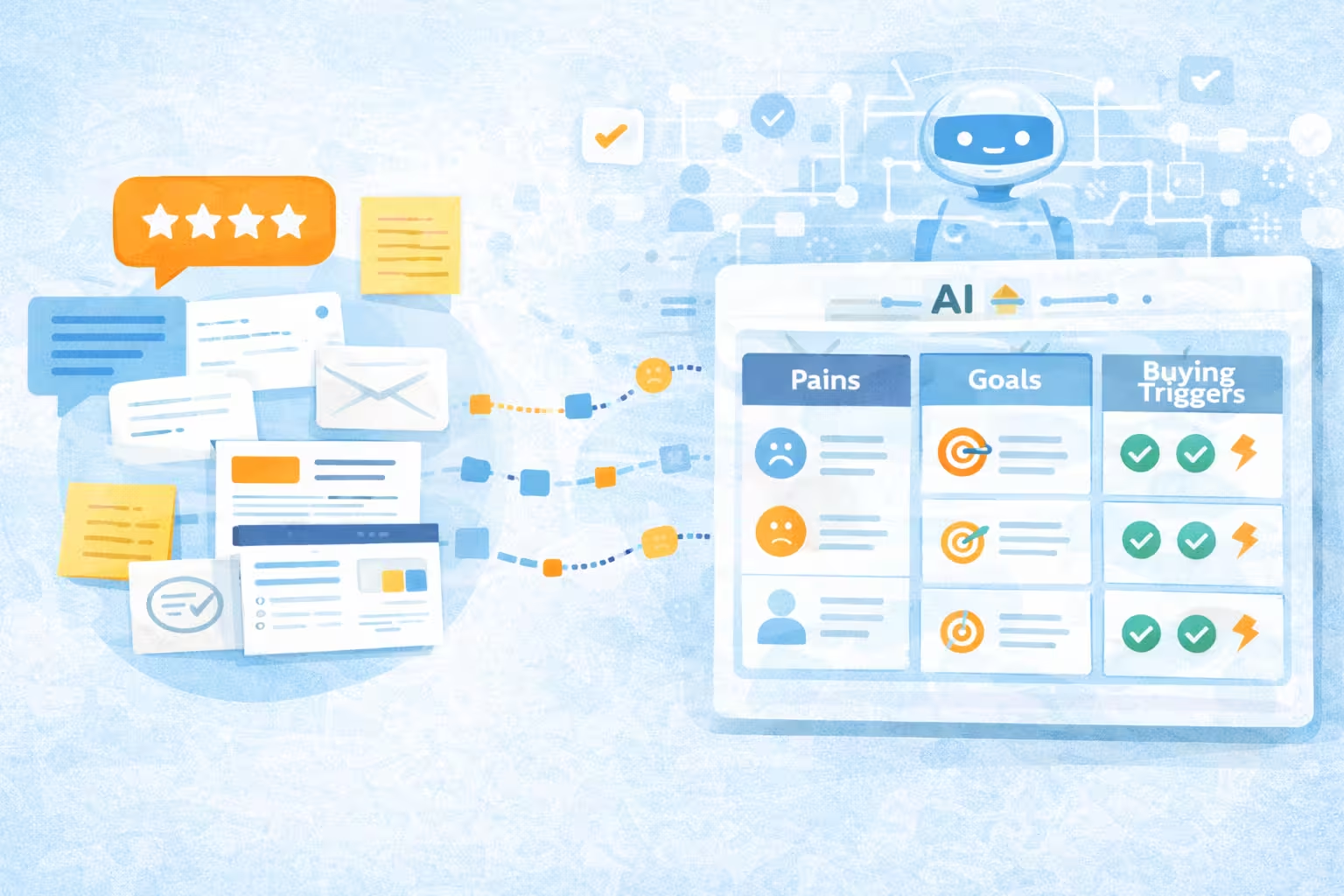
AI is like an extra strategy brain that works 24/7—and tools like BizClearAI are designed specifically to turn that intelligence into structured business decisions.
In many cases, it can even replace hours of manual research or outsourced work—especially when used strategically (as shown in this guide on replacing outsourcing with AI for small businesses).
For ICP work, it can:
Provide feedback on your customers
Turn messy notes into clear profiles
Suggest questions to ask customers
Draft multiple ICP versions for testing
Many of these outputs are powered by structured frameworks and reusable prompts—like those found in a Prompt Library built for small business workflows.
Here’s how to use BizClearAI specifically in this process.
5.1. Brainstorm Your First Draft ICP
You can start with something as simple as:
“BizClearAI, I run a [type of business] that sells [product/service] to [audience, if known]. Our best customers tend to [describe behaviors or examples]. Help me draft a first version of our Ideal Customer Profile.”
BizClearAI can then:
Suggest demographics and firmographics
Highlight likely pains and goals
Propose where they spend time online
5.2. Analyze Your Existing Customer List
If you have a spreadsheet or CRM (even basic):
Export a list of your best customers (remove names and sensitive data).
Summarize their traits: industry, location, size, spend, etc.
Share the summary with BizClearAI and ask:
“Here are patterns from my top 30 customers. Help me identify common traits and describe an Ideal Customer Profile in plain language.”
You’ll get a structured ICP you can refine.
5.3. Turn Customer Feedback into Insights
Copy and paste:
Email inquiries
Reviews
Survey responses
Call notes
Then ask:
“Read this feedback from my customers and extract:
Top 5 frustrations
Top 5 goals
Key words or phrases they use often.”
BizClearAI will pull out the repeated themes and language that should go straight into your ICP and marketing.
5.4. Create Multiple ICP Variations to Test
Sometimes you may have more than one ideal customer type.
Example:
ICP A: “New business owners in their first year”
ICP B: “Established business owners wanting to scale from 6 to 7 figures”
You can ask BizClearAI:
“Help me write two separate Ideal Customer Profiles for these two customer types, and show how my messaging, offers, and pricing might differ for each.”
Then you can test which segment responds better to your marketing.
5.5. Turn Your ICP into Actual Marketing Assets
Once you have your ICP, BizClearAI can help you translate it into:
Website headlines
Ad copy
Email sequences
Social media content topics
For example:
“Using this Ideal Customer Profile [paste ICP], write 3 Facebook ad headlines and 3 Instagram post ideas that speak directly to their pains and goals.”
Now your ICP isn’t just a document—it’s a money-making tool.
And when combined with automation and AI systems, it can significantly reduce time spent on repetitive marketing tasks.
👉Best Solutions For Replacing Outsourcing with AI for Small Businesses (2026 Guide)
6. Common Mistakes to Avoid When Defining Your ICP
A few traps to watch out for:
Mistake 1: Being Too Vague
“Small business owners” is usually too broad.
Narrow by:
Industry
Stage of growth
Specific problem or use case
Mistake 2: Making It Up Without Data
Don’t rely only on what you think your customers want.
Use:
Real feedback
Sales call notes
Customer interviews
Reviews and testimonials
AI can help summarize and spot patterns, but the raw insights should come from real people.
Mistake 3: Treating Your ICP as Fixed Forever
Your ICP will evolve as:
Your business grows
You launch new offers
Markets change
Revisit it every 6–12 months. BizClearAI can help you compare “old” vs. “new” patterns quickly.
Mistake 4: Confusing ICP with “Buyer Persona”
Quick distinction:
ICP: The type of company or person that is the right fit overall
Buyer persona: A more detailed, almost “fictional character” representation of one buyer (e.g., “Marketing Mary,” “Stressed Steve”)
ICP is the strategic filter. Buyer personas are the storytelling version. You can use AI to help with both.
7. Putting It All Together
Defining your Ideal Customer Profile is not a “nice-to-have” project. It’s the foundation for:
Smarter marketing
Easier sales
Better products and services
A more focused and profitable business
And you don’t have to do it alone.
With AI tools like BizClearAI, you can:
Turn scattered notes into a clear ICP
Analyze client patterns quickly
Extract messaging from real customer language
Draft and test different ICP versions
Convert your ICP into ready-to-use copy and campaigns
The more clearly you define your ideal customer, the more your business feels like it’s working with you, not against you. ✅
Below is a plug-and-play Ideal Customer Profile (ICP) template to create an ICP as provided by BizClearAI. Create your own customized ICP using BizClearAI.
How to Use BizClearAI With This Template
At each stage, you can give BizClearAI your draft answers and ask:
“Here is my draft ICP. What’s missing or unclear?”
“Help me turn this ICP into 5 content ideas and 3 ad angles.”
“Compare these two ICP versions and suggest which might be more profitable.”
This turns your ICP from a static document into a living strategy tool that drives your marketing, sales, and product decisions.
Share this post
Get Your Actionable Strategy Now
Join the many entrepreneurs using BizClearAI to scale faster and smarter.
No credit card required • Get 70 credits free every month