
What Should a Small Business Owner Focus on First When Everything Feels Urgent?
Jul 14, 2026
20 min read
Want a Custom AI Consultation?
Experience how BizClearAI can transform your business with immediate, actionable insights and AI-powered consulting.
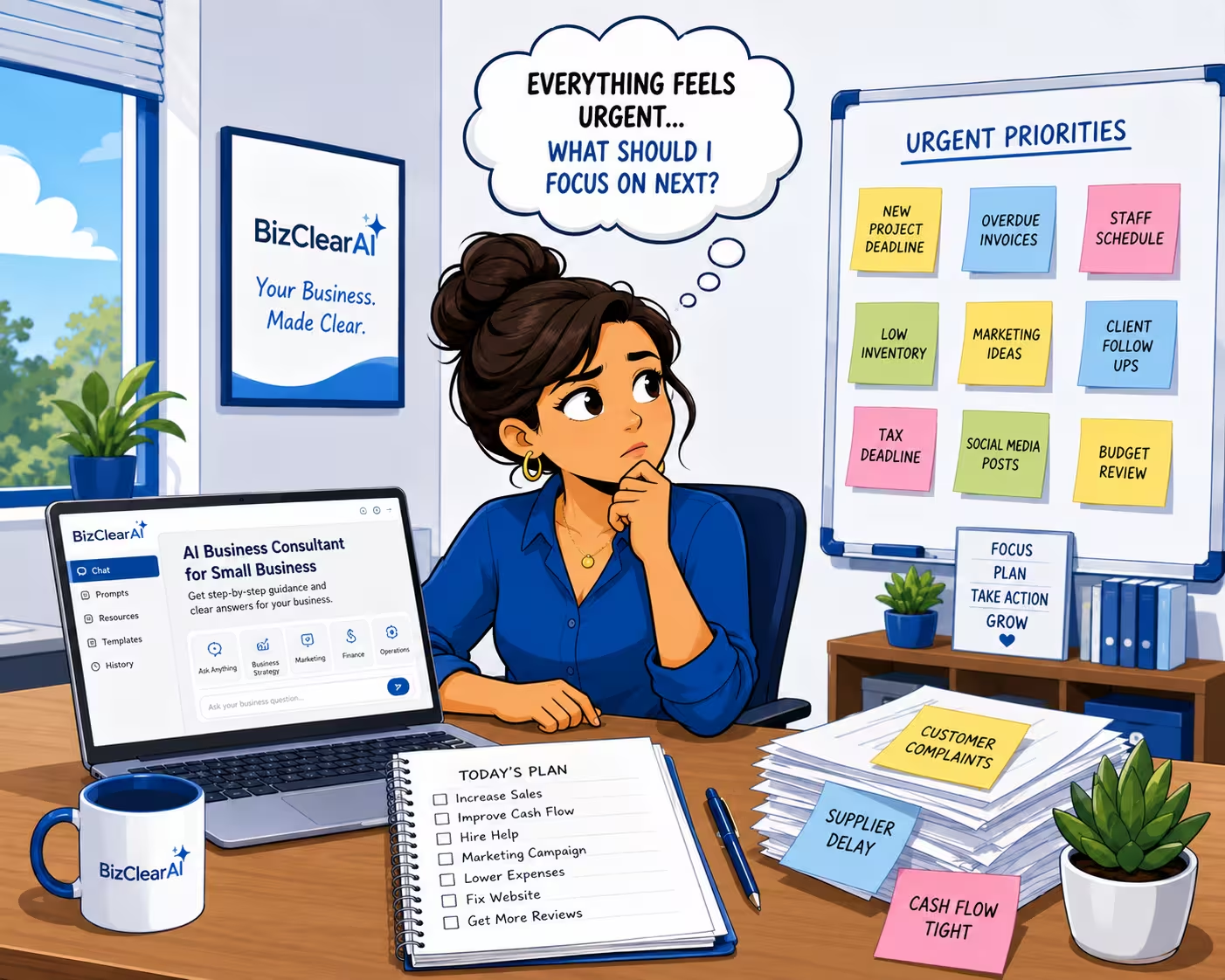
Running a small business can feel like managing ten emergencies at the same time.
A customer needs a response. An employee called out. Cash is tighter than expected. A supplier raised prices. Sales are slowing. Your website needs updating. You have not posted on social media in two weeks. And somewhere in the middle of all that, you are supposed to plan for growth.
The problem is not always that there is too much work. The bigger problem is that every issue appears equally important.
When small business priorities are unclear, owners tend to react to whatever is loudest, newest, or easiest to complete. That can create a busy day without producing meaningful progress.
Direct Answer: What Should a Small Business Owner Focus on First?
A small business owner should first focus on the issue that poses the greatest immediate threat to cash flow, customers, revenue, or business continuity. After urgent risks are controlled, the next priority should be the bottleneck that is preventing the business from serving customers, generating sales, or operating efficiently.
The goal is not to fix everything at once. It is to identify the one issue that will make the biggest difference if addressed now.
Why Everything Feels Urgent in a Small Business
Large companies usually have separate people responsible for sales, finance, customer service, operations, hiring, and marketing.
Small business owners often handle several of those functions themselves.
That means problems do not arrive in organized categories. They arrive through phone calls, emails, text messages, employee questions, customer complaints, overdue invoices, and unexpected expenses.
This creates three common challenges.
Urgent tasks are mixed with important tasks
An urgent task demands immediate attention. An important task improves the health of the business.
Sometimes a task is both urgent and important, such as resolving a major customer complaint or dealing with a missed payroll obligation.
Other times, something feels urgent simply because someone is waiting for an answer.
For example, responding to a low-priority vendor email may feel urgent. Reviewing why the business lost five recent sales may be far more important.
Visible problems receive more attention than hidden problems
Small business owners naturally respond to problems they can see.
An empty appointment slot is visible. A declining customer retention rate may not be.
A broken piece of equipment is obvious. A slow lead response process may quietly cost the business sales for months.
Some of the most damaging business problems do not announce themselves. They appear as small leaks in revenue, time, productivity, or customer loyalty.
Owners often prioritize based on stress instead of impact
When a problem creates anxiety, it can feel more important than it really is.
An owner may spend two hours redesigning a flyer because marketing feels uncertain, while ignoring overdue invoices that are creating a cash shortage.
Stress is real, but it is not always a reliable way to rank priorities.
The better question is:
What will happen to the business if this issue is not addressed soon?
The Five Areas That Should Drive Small Business Priorities
When everything feels urgent, evaluate each issue using five categories:
Immediate risk
Cash flow
Customers
Revenue
Operational capacity
These areas are not always separate. A customer service problem can affect revenue. An employee shortage can affect customer retention. A cash flow issue can limit your ability to purchase inventory.
The purpose of the categories is not to create more complexity. They help you see which problems have the greatest consequences.
1. Address Immediate Business Risks First
The first priority should be any problem that could seriously harm the business if it is ignored.
Examples include:
Payroll may not be covered.
A legal or regulatory deadline is approaching.
A serious safety issue exists.
A major customer relationship is at risk.
Essential equipment has failed.
A key supplier has stopped deliveries.
The business cannot fulfill existing commitments.
A cybersecurity or data issue may affect customers.
These issues usually need immediate attention because the cost of delay may be significant.
A simple risk question
Ask:
Could ignoring this issue for seven days cause major financial, legal, safety, or customer damage?
When the answer is yes, the issue belongs near the top of the list.
Not every risk requires panic. It requires a clear response.
Define the immediate action needed to stabilize the situation, assign responsibility, and decide what follow-up is required.
2. Protect Cash Flow Before Chasing New Ideas
A business can be profitable on paper and still struggle because there is not enough cash available to pay current expenses.
That is why cash flow should be one of the first filters used when setting small business priorities.
Potential warning signs include:
Customers are paying late.
Credit card balances are increasing.
Payroll is becoming difficult to cover.
Inventory is tying up too much cash.
Expenses have increased without a matching increase in revenue.
The owner does not know how much cash will be available next month.
The business is discounting too heavily just to generate sales.
Small business owners may be tempted to respond by launching a new promotion or spending more on advertising. But additional sales do not always solve a cash flow problem, especially when margins are low or payment is delayed.
Start by understanding the timing of money coming in and going out.
Questions to ask about cash flow
How much cash is available now?
What must be paid in the next 30 days?
Which customer payments are overdue?
Which expenses can be reduced, delayed, or renegotiated?
Which products or services generate cash fastest?
Are current prices covering the real cost of delivering the work?
A Federal Reserve Small Business Credit Survey has repeatedly identified financial challenges, including paying operating expenses and managing uneven cash flow, as common concerns for small businesses.
3. Fix Problems That Are Hurting Current Customers
Existing customers deserve priority over speculative opportunities.
It usually costs less to retain a good customer than to replace one, and unhappy customers can affect reviews, referrals, repeat purchases, and local reputation.
Customer-related priorities may include:
Unanswered complaints
Missed appointments
Late projects
Poor communication
Inconsistent service
Product quality problems
Confusing billing
Slow response times
Employees giving customers different information
The first step is to determine whether the issue affects one customer or reflects a larger pattern.
One missed call may be an isolated mistake. Ten missed calls may indicate that the business needs a better phone or lead follow-up system.
When several business problems compete for attention, protect existing customer relationships before pursuing lower-probability growth opportunities. Customer trust, repeat business, and referrals are difficult to rebuild once they are lost.
4. Prioritize the Revenue Bottleneck, Not Just More Marketing
When revenue is weak, owners often assume the business needs more leads.
Sometimes that is true. But the real problem may happen later in the sales process.
A business may have:
Plenty of leads but slow follow-up
Many estimates but a low closing rate
Strong first-time sales but few repeat customers
High website traffic but weak calls to action
Frequent inquiries from the wrong type of customer
Good sales volume but poor profit margins
Before spending money on marketing, identify where revenue is breaking down.
The basic revenue path
Most small businesses move customers through a simple path:
Awareness → Inquiry → Response → Quote or Offer → Sale → Delivery → Repeat Business or Referral
Look for the weakest step.
For example:
If awareness is low, the business may need better visibility.
If inquiries are strong but sales are weak, the problem may be follow-up, pricing, trust, or the sales conversation.
If sales are strong but repeat business is low, the problem may be service quality or customer retention.
If revenue is growing but cash is not, margins or payment terms may be the issue.
Marketing should not automatically become the top priority just because the owner wants more revenue. First determine whether the business is converting and retaining the opportunities it already has.
5. Fix the Operational Constraint Slowing Everything Else Down
A business bottleneck is the point where work repeatedly becomes delayed, inconsistent, or dependent on one person.
Common operational bottlenecks include:
Every decision must go through the owner.
Quotes are taking too long to prepare.
Employees do not know the correct process.
Scheduling is disorganized.
Inventory is frequently unavailable.
Customer information is stored in several places.
Work is completed, but invoices are sent late.
One employee is the only person who knows how to complete a critical task.
A bottleneck deserves priority when fixing it will improve several areas of the business at once.
For example, improving the quoting process may increase response speed, sales conversion, customer satisfaction, and owner capacity.
That is often more valuable than completing five unrelated small tasks.
The best priority is often the constraint affecting the greatest number of outcomes. Fixing one central bottleneck can improve revenue, customer service, productivity, and cash flow at the same time.
A Practical Framework for Ranking Small Business Priorities
Use the following framework whenever too many issues are competing for attention.
The R-C-C-R-O Priority Framework
Score each issue based on five factors:
Risk
Cash flow
Customers
Revenue
Operations
Give each factor a score from 0 to 3.
Scoring guide
0 — No meaningful effect
The issue has little or no impact in this area.
1 — Low effect
The issue matters, but a short delay is unlikely to cause significant damage.
2 — Moderate effect
The issue is creating noticeable problems or lost opportunities.
3 — High effect
The issue may cause immediate harm, lost customers, serious financial pressure, or business disruption.
Add the scores together.
The issue with the highest total should usually receive attention first.
Copyable Small Business Priority Template
Issue:
[Describe the problem in one sentence.]
What happens if I wait seven days?
[Describe the likely consequence.]
Risk score, 0–3:
[ ]
Cash flow score, 0–3:
[ ]
Customer score, 0–3:
[ ]
Revenue score, 0–3:
[ ]
Operations score, 0–3:
[ ]
Total score:
[ ]
What is the smallest action that would stabilize or improve this issue?
[Write one specific action.]
Who is responsible?
[Name the person.]
When will the action be completed?
[Date and time.]
How will we know the issue is improving?
[Choose one measurable sign.]
This framework does not replace judgment. It helps prevent emotion, noise, and interruptions from making every decision for you.
How to Turn a Long Problem List Into a Clear Action Plan
Step 1: Write down every issue
Do not keep the entire list in your head.
Spend ten minutes listing every problem, concern, project, and decision that currently feels urgent.
Do not rank anything yet.
Examples might include:
Follow up with unpaid customers
Hire another technician
Update the website
Respond to negative review
Order inventory
Improve scheduling
Post on social media
Review pricing
Finish tax documents
Train new employee
Writing everything down reduces the mental pressure of trying to remember it all.
Step 2: Separate problems from projects
Some items are immediate problems. Others are improvement projects.
A missed payroll deadline is a problem.
Building a new employee handbook is a project.
Both may matter, but they should not be treated as equally urgent.
Mark each item as one of the following:
Immediate risk
Current business problem
Growth opportunity
Routine task
Long-term improvement
This alone often makes the true priorities easier to see.
Step 3: Score the most important items
Do not spend an hour scoring every minor task.
Choose the five to ten issues with the greatest potential impact and use the R-C-C-R-O framework.
The purpose is to compare competing priorities, not create more administrative work.
Step 4: Choose one primary priority
Your primary priority is the issue that deserves the most focused attention now.
It does not mean every other task stops. Customers still need responses, employees still need support, and routine work still needs to happen.
It means one issue receives protected time, clear ownership, and a defined outcome.
A useful statement is:
Our main business priority this week is to ______ because it is affecting ______.
For example:
“Our main business priority this week is reducing quote turnaround time because slow quotes are causing us to lose qualified leads.”
Step 5: Define a stabilizing action
Do not try to solve the entire problem in one step.
Choose the first action that reduces damage or creates clarity.
Examples include:
Call the five largest overdue accounts.
Contact the supplier and secure a temporary delivery.
Return every open lead from the past three days.
Speak with the dissatisfied customer and offer a resolution.
Review the last ten lost estimates.
Create a one-page checklist for opening and closing the store.
Send all completed but unbilled work to accounting.
A good first action is specific, small enough to complete, and directly related to the priority.
Step 6: Set a measurable result
A priority without a measurable result can remain open indefinitely.
Choose one sign that shows progress.
Examples include:
Reduce overdue receivables by $5,000.
Respond to all new leads within 15 minutes during business hours.
Send quotes within one business day.
Reduce scheduling errors to fewer than two per week.
Contact every dissatisfied customer within 24 hours.
Increase the estimate-to-sale conversion rate from 25% to 35%.
You do not need a complicated dashboard. You need a way to tell whether the action worked.
Step 7: Reassess weekly
Small business priorities change.
A cash flow problem may stabilize. A staffing issue may become more urgent. A new customer opportunity may deserve attention.
Set aside 20 to 30 minutes each week to review:
What improved?
What became worse?
What is still blocked?
What new risk appeared?
What should be the primary priority next week?
A weekly review helps owners become less reactive because decisions are made deliberately rather than during the middle of a crisis.
Small Business Priority Example 1: The Plumbing Company
A plumbing business owner is dealing with several issues:
The company website looks outdated.
Two customers have not paid large invoices.
A technician has been arriving late.
The business has 14 open estimates that have not received follow-up.
The owner wants to start posting videos on social media.
The website and social media may help future growth, but the overdue invoices and open estimates have a more immediate effect on cash flow and revenue.
The owner decides to prioritize:
Collecting overdue invoices
Following up on open estimates
Addressing the technician’s attendance
Updating the website later
The first action is to call the two overdue customers and assign an office employee to follow up on every open estimate within 24 hours.
This priority does not require a large new marketing campaign. It focuses on money and opportunities already within the business.
Small Business Priority Example 2: The Hair Salon
A salon owner feels overwhelmed because:
Online reviews have slowed.
One stylist may leave.
Appointment gaps are increasing.
The salon’s retail display needs updating.
Customers frequently wait past their appointment times.
The waiting-time problem is affecting the current customer experience and may be contributing to fewer repeat bookings and reviews.
The owner reviews the schedule and discovers that services are consistently booked too close together.
The primary priority becomes improving appointment scheduling and service timing.
The salon adds realistic buffers between certain services, gives the front desk a delay-notification script, and tracks how often appointments start late.
By fixing the customer experience first, the salon may improve retention, reviews, employee stress, and schedule reliability.
Small Business Priority Example 3: The Independent Consultant
A consultant believes the main problem is not having enough leads.
However, a closer review shows:
Six proposals are still open.
Several past clients have not been contacted in over a year.
The consultant spends hours customizing each proposal.
Invoices are sometimes sent a week after work is completed.
The consultant is considering paying for a new lead generation service.
The real problem is not necessarily lead volume.
The consultant already has unclosed opportunities, past client relationships, and delayed billing.
The priority becomes tightening the proposal and follow-up process.
The consultant creates one proposal template, schedules follow-up dates before sending each proposal, contacts past clients, and sends invoices immediately after project milestones.
Only after those steps are completed does the consultant evaluate whether more lead generation is necessary.
Common Mistakes When Setting Small Business Priorities
Mistake 1: Prioritizing the easiest task
Completing small tasks can create a sense of progress.
But clearing emails, adjusting a logo, reorganizing files, or updating social media may not address the issue causing the greatest business damage.
Easy tasks are not automatically unimportant. They simply should not replace higher-impact work.
Mistake 2: Letting the loudest person set the agenda
Employees, customers, vendors, and partners may all believe their request is urgent.
Listen carefully, but evaluate the business impact before changing priorities.
A loud request may need a quick acknowledgment without becoming the owner’s primary focus.
Mistake 3: Treating every revenue problem as a marketing problem
More marketing does not fix:
Slow lead response
Weak sales conversations
Poor customer service
Uncompetitive offers
Low margins
Inconsistent follow-up
Limited capacity
Bad reviews
Before trying to attract more prospects, review how well the business handles existing opportunities.
Mistake 4: Starting too many improvement projects
An owner may decide to fix pricing, rewrite procedures, redesign the website, hire an employee, launch a referral program, and automate follow-up at the same time.
Each project may be useful. Together, they may create more unfinished work.
Choose one main operational or growth improvement at a time, especially when the same people are responsible for implementing all of them.
Mistake 5: Confusing motion with progress
A full calendar does not prove that the highest-impact issue is improving.
At the end of each week, ask:
What problem did we reduce?
What result changed?
What is easier, faster, safer, or more profitable now?
If those questions are difficult to answer, the business may be active without making meaningful progress.
Mistake 6: Ignoring recurring problems
Repeated problems should not be handled as unrelated emergencies.
If appointments are frequently missed, quotes are repeatedly late, or employees keep asking the same questions, the business likely needs a process.
The first occurrence may require a quick fix.
The repeated occurrence requires a system.
How AI Can Help Clarify Competing Business Priorities
AI can be useful when an owner has too many problems to evaluate objectively.
The owner can describe the current issues, available cash, staffing limitations, customer concerns, and business goals. AI can then help organize the issues by risk, cash flow, customer impact, revenue, and operational effect.
It can also help create:
A ranked priority list
A 7-day action plan
A cash flow checklist
A customer response script
A lead follow-up process
A simple SOP
A weekly owner dashboard
A decision matrix
A staff responsibility list
AI should not make high-stakes legal, financial, or employment decisions on behalf of the owner. It can help structure information, identify missing questions, compare options, and turn a scattered problem list into an organized plan.
Copyable AI prompt for setting business priorities
“I run a [type of business] with [number of employees or team structure]. These are the issues currently competing for my attention: [list issues]. My current concerns about cash flow are [details]. My biggest customer problems are [details]. My revenue goals are [details]. Rank these issues based on immediate risk, cash flow, customer impact, revenue impact, and operational impact. Explain which issue I should focus on first, what I should postpone, and give me a practical 7-day action plan.”
A Simple Rule for Deciding What to Do Today
When you still feel stuck, use this order:
Prevent serious damage.
Protect available cash.
Take care of current customers.
Capture existing revenue opportunities.
Remove the biggest operational bottleneck.
Work on growth.
Complete low-impact administrative tasks.
This order will not fit every situation perfectly, but it is more reliable than choosing tasks based on stress, habit, or whoever contacted you most recently.
How BizClearAI Can Help Build a Clearer Action Plan
BizClearAI helps small business owners turn competing problems into practical, step-by-step plans based on their actual business.
An owner can use it to organize priorities, compare decisions, create a weekly action plan, build an SOP, draft a customer script, review pricing, prepare a cash flow checklist, or identify the next operational improvement.
Because the guidance can be shaped around the owner’s business type, goals, customers, and current challenges, the result is more useful than a generic list of productivity tips.
Final Takeaway
When everything feels urgent, do not try to work faster on everything.
Identify the issue with the greatest effect on risk, cash flow, customers, revenue, or operations. Stabilize that issue first, define one measurable outcome, and postpone lower-impact work until the business has the capacity to address it properly.
Clear priorities do not eliminate business problems. They help owners solve the right problem before it becomes a bigger one.
Frequently Asked Questions About Small Business Priorities
What should a small business owner prioritize every day?
A small business owner should prioritize immediate risks, cash flow needs, customer commitments, active sales opportunities, and operational problems that are blocking work. Routine administrative tasks should be completed after higher-impact issues are under control.
How do I prioritize when every business task feels important?
List the tasks and compare them based on what will happen if they are delayed. Give priority to tasks that affect business survival, cash availability, customer trust, current revenue, or the ability to deliver products and services.
Should cash flow always be the top small business priority?
Cash flow should be a top priority when the business may struggle to meet payroll, pay suppliers, cover debt, or fund normal operations. When cash is stable, another issue such as customer retention, sales conversion, staffing, or operational capacity may deserve more attention.
Is getting more customers always the most important goal?
No. More customers will not solve every business problem. A business may first need to improve pricing, margins, lead follow-up, service quality, capacity, collections, or customer retention before investing heavily in customer acquisition.
How many priorities should a small business have at one time?
A small business can have several responsibilities, but it should usually have one primary improvement priority at a time. A single main focus makes it easier to assign responsibility, protect time, measure progress, and complete the work.
How often should small business priorities be reviewed?
Small business priorities should be reviewed at least once a week. They should also be reassessed when there is a major change in cash flow, staffing, customer demand, supplier availability, legal obligations, or business risk.
Can AI help a small business owner decide what to focus on?
Yes. AI can help organize business problems, compare their likely impact, identify missing information, and create a practical action plan. The owner should still review the recommendations and use professional advice for legal, tax, financial, or other high-stakes decisions.
Share this post
Get Your Actionable Strategy Now
Join the many entrepreneurs using BizClearAI to scale faster and smarter.
No credit card required • Get 70 credits free every month