

The Hidden ROI of Using AI in Your Small Business
Mar 24, 2026
10 min read
Want a Custom AI Consultation?
Experience how BizClearAI can transform your business with immediate, actionable insights and AI-powered consulting.
Running a small business means every hour, dollar, and decision matters. That is why more owners are starting to ask a practical question: what is the real ROI of AI for a small business?
Quick Answer: What Is AI ROI for Small Businesses?
AI ROI for small businesses is the measurable return a business gets from using AI tools compared to what those tools cost. It can be measured through time saved, reduced labor costs, increased sales, faster customer follow-up, fewer mistakes, better marketing output, or improved operational efficiency. The best way to calculate AI ROI is to start with one use case, estimate the value of the time or revenue gained, subtract the AI cost, and compare the result to what the business spent.
The answer is bigger than most people expect.
When people hear “AI,” they often think about flashy tools, big budgets, or complicated technology. But in small businesses, the return usually comes from simpler wins. AI helps you save time, reduce manual work, improve consistency, respond faster, and make better decisions. Those improvements may look small at first, but they compound fast.
That is what makes AI such a strong growth tool. It does not just add another app to your stack. Used well, it creates more capacity inside your business.
At BizClearAI, we see this pattern often: the biggest gains do not always show up as instant new revenue. They show up as reclaimed hours, fewer costly errors, quicker turnaround times, and a team that can focus on higher-value work.
If you are still in the planning stage, read How to Build a Small Business AI-Ready Business Strategy (Without Tech Overwhelm) so your AI rollout starts with the right priorities.
What AI ROI Really Means for a Small Business
ROI stands for return on investment. In simple terms, it answers one question:
Is this giving my business more value than it costs?
For AI, that value can come from both direct and indirect results.
Direct AI ROI
Direct ROI is easier to see. It might look like:
More leads from better marketing
More conversions from faster follow-up
Lower support costs
Reduced admin time
Indirect AI ROI
Indirect ROI is where many small businesses miss the bigger picture. It might include:
Faster task completion
Better decision-making
Fewer mistakes
Improved customer response time
Less employee burnout
A simple formula looks like this:
AI ROI = (Value Generated by AI - Cost of AI) ÷ Cost of AI
The key is defining “value” the right way. For a small business, value is often measured in time saved, labor efficiency, reduced waste, improved output, and better customer experience.
Where Small Businesses See the Biggest ROI from AI
AI works best when it is applied to repeatable workflows, not random one-off tasks.
Operations
Operations is one of the strongest areas for AI ROI. This includes scheduling, project updates, internal documentation, inventory support, and repetitive reporting. When AI takes care of routine admin, owners and managers get time back for actual growth work.
Marketing
Marketing is another high-return area because AI can speed up content creation, campaign analysis, ad testing, and email drafting. That means more output without needing more hours.
Customer Service
AI can answer common questions, organize tickets, and handle simple support tasks around the clock. Faster response times often improve both efficiency and customer satisfaction.
Finance and Reporting
AI can help organize expenses, flag anomalies, summarize trends, and support forecasting. Better visibility often leads to better margins.
Hiring and HR
AI can speed up job descriptions, resume screening, onboarding drafts, and internal training materials. That saves time while making hiring systems more consistent.
For practical ideas you can implement quickly, read 10 AI Admin Automations That Save Time, Reduce Errors, and Cut Costs.
The Most Overlooked ROI Metric: Time Saved
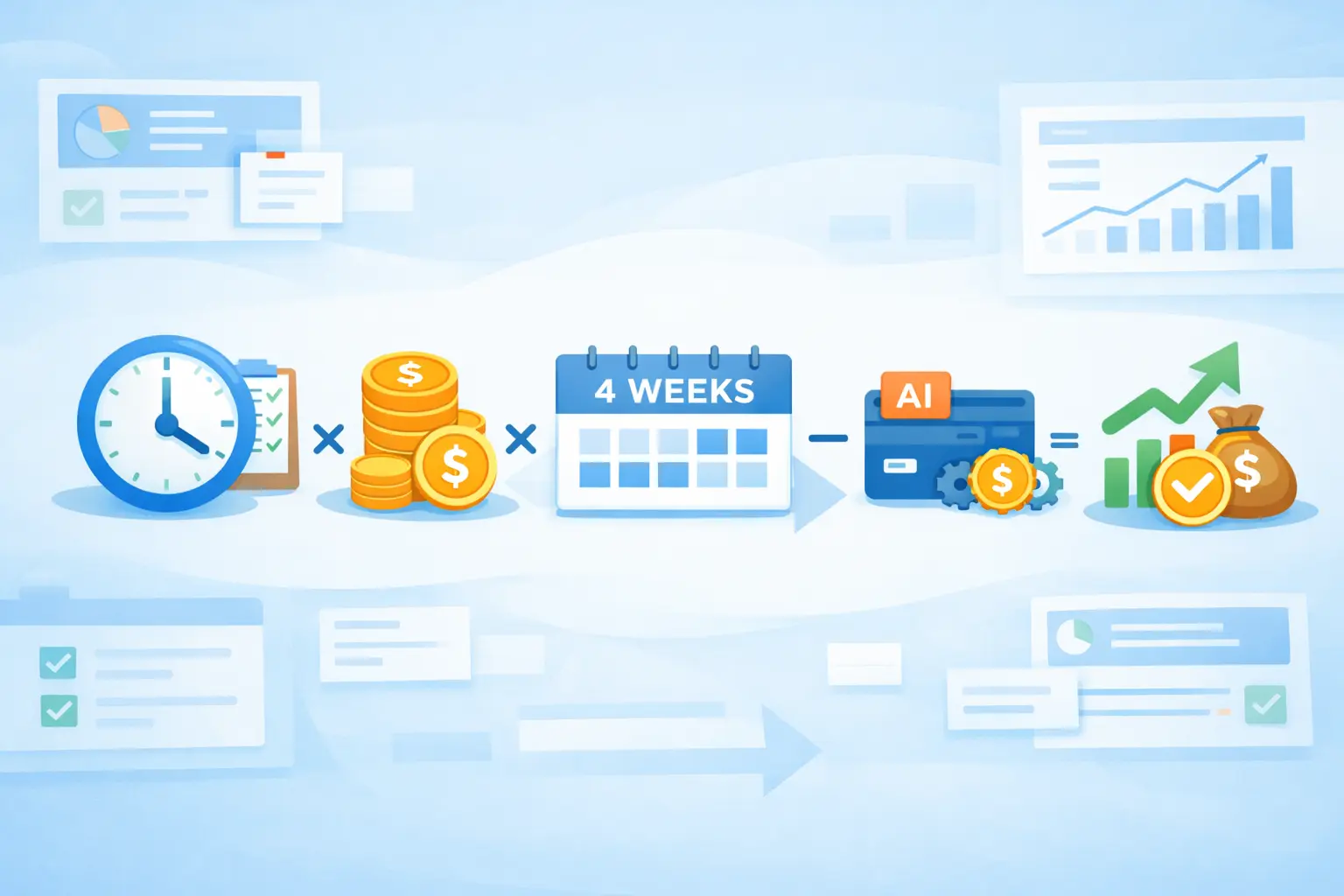
For many owners, time is the hidden profit leak.
A task that eats 30 minutes a day may not feel dramatic in the moment. But over a month, those minutes turn into hours. Over a year, they become weeks of working time.
AI often produces value by automating or accelerating tasks like:
Writing follow-up emails
Drafting reports
Summarizing meetings
Creating proposals
Sorting support questions
Organizing recurring admin work
A Simple Time Savings Formula
Use this to estimate monthly value:
(Hours Saved per Week x Hourly Value of Time x 4) - Monthly AI Cost
Example
Let’s say AI helps save:
5 hours per week
Your time is worth $40 per hour
Tool cost is $20 per month
That gives you:
(5 x 40 x 4) - 20 = $780 in net monthly value
That is a meaningful return from one improvement.
If you are not sure where to start, the Prompt Library helps readers move from theory into actual use cases and workflows.
ROI in Operations: The Efficiency Dividend
Operational efficiency may not sound exciting, but it is often where AI creates the fastest payoff.
Think about all the work required to keep things moving:
Assigning tasks
Scheduling jobs
Updating records
Writing summaries
Tracking inventory or orders
Organizing internal communication
Example: Scheduling and Job Assignment
A four-person landscaping business uses AI-assisted scheduling to manage routes and daily assignments.
Before AI, the owner spent around 3 hours per day coordinating jobs. After AI, that dropped to 30 minutes per day.
That saves 2.5 hours per day, or roughly 12.5 hours per week.
If that owner’s time is worth $50 per hour:
12.5 x 50 x 4 = $2,500 in monthly value
If the software costs $100 per month:
ROI = (2,500 - 100) ÷ 100 = 2,400%
That is not just a software win. That is real owner capacity being returned to the business.
If you need help getting from idea to execution, read The Step-by-Step Guide to Launching Your First AI Project for a Small Business.
ROI in Marketing: Faster Output, Better Testing, More Reach
Marketing is one of the clearest examples of AI ROI for small business owners because it improves both speed and consistency.
AI can help with:
Social captions
Blog outlines
Email campaigns
Ad copy variations
Keyword brainstorming
Campaign performance summaries
Example: Content Production
A local gym uses AI to draft weekly email newsletters and social media content.
Before AI, the work took about 6 hours per week. With AI support, it now takes 1 hour.
That saves 5 hours per week.
If marketing time is valued at $40 per hour:
5 x 40 x 4 = $800 in monthly value
If the AI tool costs $30 per month:
ROI = (800 - 30) ÷ 30 = 2,567%
And that is before measuring the impact of publishing more consistently or testing more creative variations.
This is why AI in marketing is not just about writing faster. It is about creating more opportunities to improve performance without adding more workload.
ROI in Customer Service: Faster Responses Without More Payroll
Customer service is another area where AI can deliver quick and measurable returns.
Small teams often spend too much time answering the same basic questions:
Where is my order?
What is your return policy?
How do I book or reschedule?
Which product is right for me?
AI can handle a large share of these repetitive requests.
Example: Ecommerce Support
A small e-commerce store receives 300 support inquiries per month. An AI chatbot resolves 80% of those automatically.
That means 240 inquiries no longer need manual handling.
If each manual reply previously took 10 minutes, then the business saves:
240 x 10 minutes = 2,400 minutes, or 40 hours per month
If support labor is valued at $18 per hour:
40 x 18 = $720 in monthly labor value
If the chatbot costs $200 per month:
ROI = (720 - 200) ÷ 200 = 260%
That is already a solid return. The added benefit is faster response time, better customer experience, and stronger retention.
ROI in Finance: Better Decisions and Less Waste
Some of the most valuable AI gains are less visible, but just as important.
Finance-related AI use cases may include:
Expense categorization
Cash flow visibility
Forecasting support
Invoice tracking
Waste reduction
Margin analysis
Example: Reducing Inventory Waste
A small café uses AI-supported expense analysis to identify over-ordering in perishable inventory.
Monthly food inventory cost: $15,000
Waste reduction: 10%
That creates $1,500 in monthly savings
Even when the tool cost is modest, the return can be significant because poor financial visibility is expensive. Better decisions protect profit.
ROI in Hiring and Admin
Hiring and internal admin are often quietly expensive. AI helps by reducing repetitive work that slows down managers and office staff.
AI Can Support:
Job description drafts
Resume screening
Interview question creation
Onboarding documents
Policy summaries
Internal SOP drafting
Example: Hiring Support
If your team spends 15 hours per hire screening candidates and AI cuts that to 5 hours, that is 10 hours saved per hire.
At $30 per hour, that equals:
10 x 30 = $300 saved per hire
Multiply that across multiple roles per year, and the savings become meaningful.
A Simple AI ROI Calculator for Small Businesses
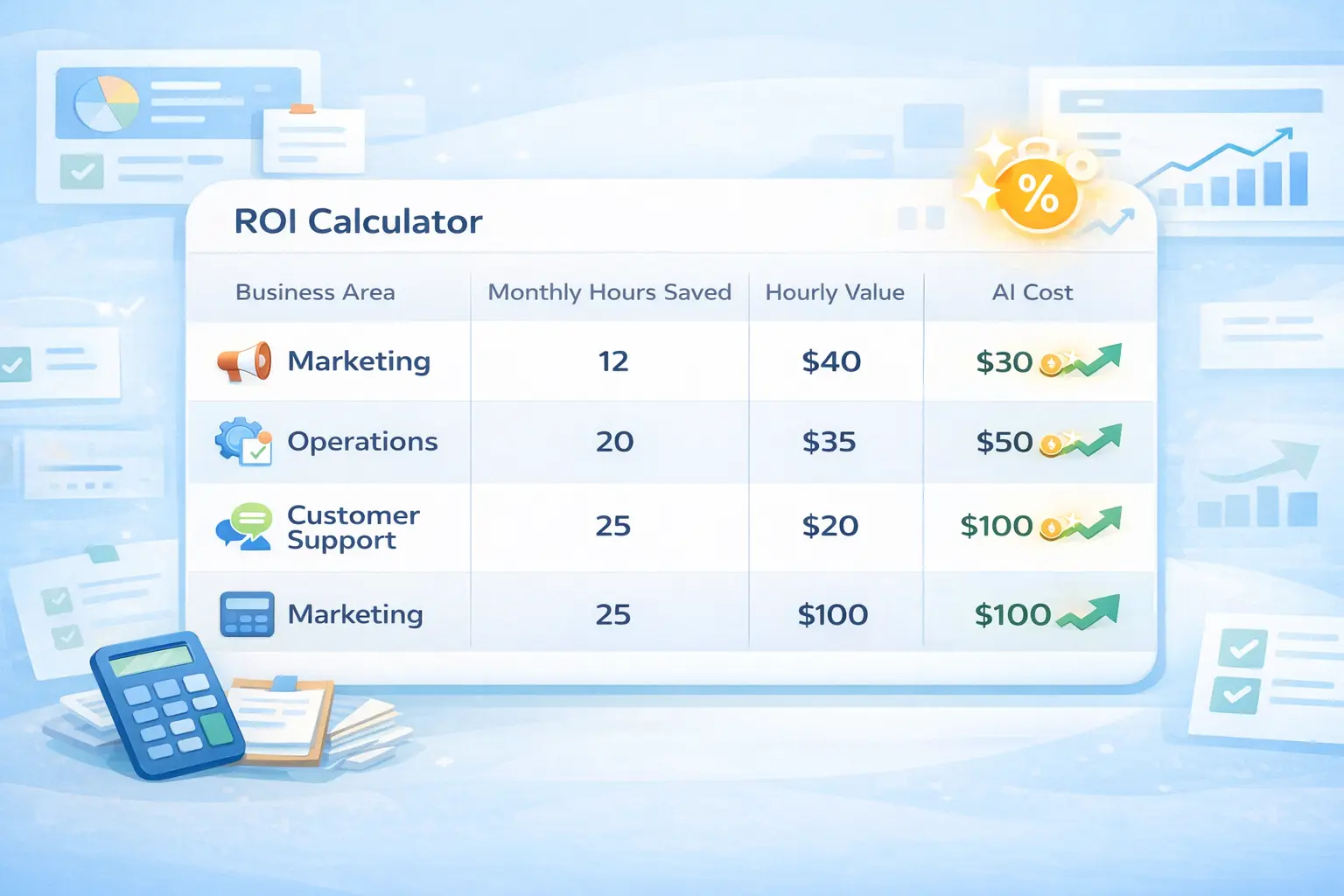
You do not need a complicated spreadsheet to estimate whether AI is worth it.
Use this formula:
ROI = ((Hours Saved x Hourly Value) - AI Cost) ÷ AI Cost x 100
Here is a quick example table:
Business Area | Monthly Hours Saved | Hourly Value | AI Cost | ROI |
Marketing | 12 | $40 | $30 | 1,500% |
Operations | 20 | $35 | $50 | 1,300% |
Customer Support | 25 | $20 | $100 | 400% |
Even moderate time savings can create strong returns when applied consistently.
The Hidden ROI Most Owners Feel Before They Measure
Not every benefit appears neatly in a spreadsheet.
There is also the ROI of:
Less stress
Faster decisions
Better team focus
More consistent customer experience
More space to work on strategy instead of admin
This is where AI becomes more than a cost-saving tool. It becomes a capacity-building tool.
Every hour saved creates room for more valuable work. Every system improved makes growth easier to manage.
Final Thoughts: The Real Value of AI Is Compounding
The hidden ROI of AI is not just about spending less. It is about creating more room to operate, improve, and grow.
That is why the best question is not, “How much does this AI tool cost?”
It is:
How much time, clarity, speed, and consistency does this give back to my business?
When you look at AI ROI through that lens, the value becomes much easier to see.
If you want to start evaluating where AI can produce the fastest return in your business, visit BizClearAI and explore the Prompt Library for practical workflows, prompts, and implementation ideas.
FAQ: AI ROI for Small Business
Is AI worth it for a small business?
Yes, when it is applied to repetitive, time-consuming work. Many small businesses see ROI from AI through time savings, improved efficiency, better customer response times, and lower admin costs.
How do you calculate AI ROI?
A simple formula is:
AI ROI = (Value Generated by AI - Cost of AI) ÷ Cost of AI
For most small businesses, value is usually based on hours saved, labor cost avoided, reduced waste, or improved marketing performance.
What business areas usually get the best AI ROI?
Operations, marketing, customer service, finance, and admin are often the strongest areas because they include repeatable workflows that AI can speed up or automate.
Does AI ROI only mean more sales?
No. Some of the best AI ROI comes from indirect gains like saving time, reducing errors, improving consistency, and helping teams make faster decisions.
What is the easiest way to start with AI?
Start with one workflow that repeats every week and already takes too much time. Measure how long it takes now, test an AI-assisted version, and compare the results over 30 days.
Share this post
Get Your Actionable Strategy Now
Join the many entrepreneurs using BizClearAI to scale faster and smarter.
No credit card required • Get 70 credits free every month