

How to Build a Lean AI-Powered Small Business Team
Mar 26, 2026
11 min read
Want a Custom AI Consultation?
Experience how BizClearAI can transform your business with immediate, actionable insights and AI-powered consulting.
Small business owners used to assume growth meant hiring more people. More sales meant more admin. More customers meant more support. More moving parts meant more payroll.
That model is getting expensive fast.
Quick Answer: How AI Improves Team Efficiency for Small Businesses
AI improves team efficiency for small businesses by helping employees complete routine tasks faster, stay organized, communicate more clearly, and reduce time spent on manual admin work. Common examples include drafting emails, summarizing meetings, creating task lists, updating procedures, answering internal questions, organizing customer information, and preparing reports. The biggest benefit is that small teams can get more done with the people they already have, without adding unnecessary complexity or hiring before they are ready.
Today, the strongest small businesses are learning a different lesson: you do not always need a bigger team to grow. You need a smarter system. That is where AI comes in.
A lean, AI-powered team is not about replacing people. It is about making every person more effective. When repetitive work is automated and decision-making is supported by better systems, a small team can operate with more speed, more consistency, and less overhead.
That is the real opportunity behind AI team small business efficiency. Instead of hiring early to patch broken processes, you can build a flexible business where humans focus on leadership, creativity, and relationships while AI handles repetitive execution.
At BizClearAI, this is one of the biggest shifts we help small businesses make. The goal is not to turn your company into a tech lab. It is to help you build a lean operating model that keeps your headcount intentional and your output high.
If you are still shaping your overall direction, start with How to Build a Small Business AI-Ready Business Strategy (Without Tech Overwhelm. It gives the strategic foundation that makes a lean AI team much easier to design.
Why Lean Teams Are Winning in the AI Era
A lean team is not simply a small team. It is a team built for leverage.
That means each person owns outcomes, not just tasks. It also means systems do more of the repetitive work that once required extra hires. In practice, that looks like automation for scheduling, reporting, onboarding, draft writing, lead follow-up, task routing, and internal communication.
AI changes the economics of team building because it reduces the cost of coordination. Work that used to require several touchpoints across multiple people can now be supported by a few well-designed workflows.
For a small business, that matters a lot. Payroll is usually one of the largest fixed costs. Every hire raises the break-even point. Every added role increases communication complexity. Every manual process creates drag.
A lean AI-powered team helps solve that by asking a better question:
What should a human own, and what should a system handle?
When you answer that clearly, your business becomes easier to run and easier to scale.
The New Definition of “Team” for Small Businesses
In the AI era, a team is no longer only made up of people. It is a combination of human talent and digital support.
What humans still do best
Humans remain essential for:
strategy
decision-making
relationship-building
creative direction
leadership
judgment
These are the parts of the business that need context, trust, taste, and accountability.
What AI does best
AI is especially useful for:
drafting
summarizing
organizing
automating recurring tasks
surfacing patterns in data
supporting faster execution
This is the work that often clogs up a small team’s day. It is necessary, but it does not always need deep human attention.
That is the mindset shift. AI should not be treated like a novelty tool. It should be treated like a support layer across the business.
Automate Before You Hire
One of the most valuable habits for a growing small business is this:
Before you hire, ask whether the problem is really labor or whether it is process.
Many owners hire because work feels heavy. But heavy does not always mean more people are needed. It may mean your workflow is too manual, too fragmented, or too dependent on one person remembering everything.
That is why lean teams follow a simple order of operations.
Step one: automate repetitive work
Start with work that happens frequently, follows a pattern, and does not require much judgment. Examples include:
calendar reminders
recurring reports
meeting summaries
email drafts
task creation
invoice follow-up
internal updates
If you need ideas, read 10 AI Admin Automations That Save Time, Reduce Errors, and Cut Costs.
Step two: augment key roles
Next, use AI to strengthen the people already on your team. A marketing lead can move faster with AI-assisted drafts and analysis. An operations manager can run a tighter ship with workflow automations. A founder can make quicker decisions with better summaries and reporting.
Step three: hire for leverage, not for volume
Only add a new role when the work truly requires human ownership. That usually means creative direction, relationship management, sales conversations, leadership, or specialized judgment.
This one principle can protect your margins more than almost any other hiring decision.
Define the Core Human Roles First
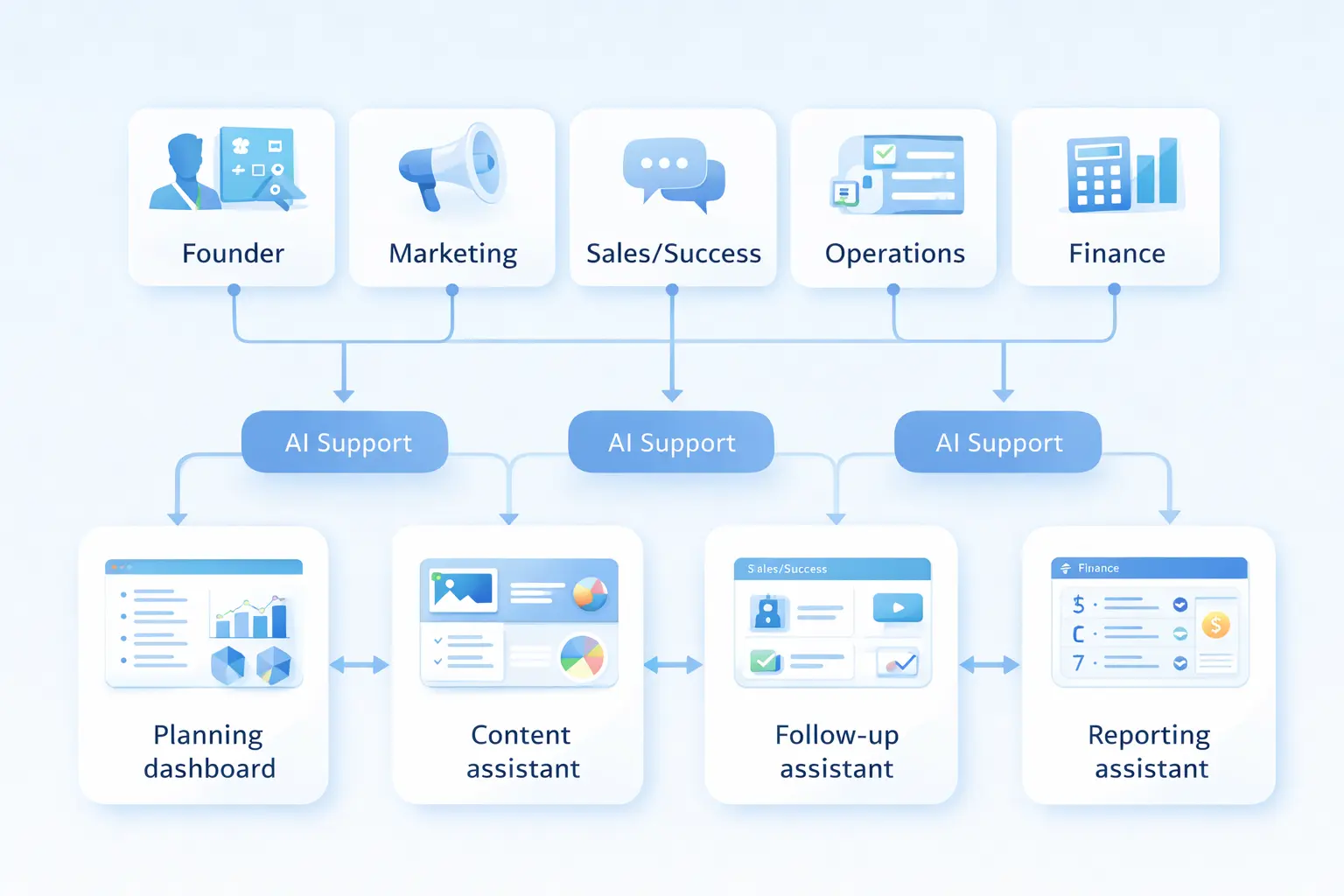
A lean AI-powered business still needs people. The difference is that each role should be designed around leverage instead of manual workload.
Founder or business owner
The founder sets priorities, makes decisions, communicates direction, and keeps the business aligned. AI can support this role with planning help, research summaries, forecasting prompts, and decision support.
Marketing lead
This person owns brand voice, positioning, messaging, and campaign strategy. AI can help with blog outlines, email drafts, ad variations, keyword research, and content repurposing.
Sales or customer success lead
This role manages relationships, follow-up, customer conversations, and retention. AI can support with CRM reminders, call summaries, FAQ drafts, and follow-up templates.
Operations lead
Operations keeps the business organized. AI can automate recurring tasks, route information, assign work, and summarize status updates so execution stays smooth.
Finance oversight
You may not need a full finance department early on, but you do need visibility. AI can support bookkeeping workflows, categorize expenses, summarize trends, and help surface margin issues faster.
This structure helps small businesses avoid overbuilding departments too early. You create a lean team where each person owns outcomes and AI reduces the amount of manual effort underneath them.
Assign AI “Team Members” With Clear Jobs
One of the easiest ways to make AI useful is to stop treating it like a vague extra tool.
Instead, assign each AI workflow a job.
For example:
an AI marketing assistant drafts captions, campaign ideas, and blog outlines
an AI admin assistant summarizes meetings and drafts routine emails
an AI operations assistant keeps tasks moving and creates weekly progress summaries
an AI support assistant handles repetitive customer questions and surfaces issues for review
This does two important things.
First, it makes AI easier for your team to adopt because everyone knows what each workflow is supposed to do.
Second, it reduces random usage. Without a defined role, AI stays inconsistent. With a clear purpose, it becomes part of how the business operates.
A practical way to manage this is to keep a shared internal document listing:
the AI assistant name or function
the tools it uses
the prompts that work best
what the human reviews before anything goes live
Your Prompt Library is a natural internal destination here because it gives teams a starting point for standardized usage.
Build AI-Enhanced Workflows, Not Just AI Tasks
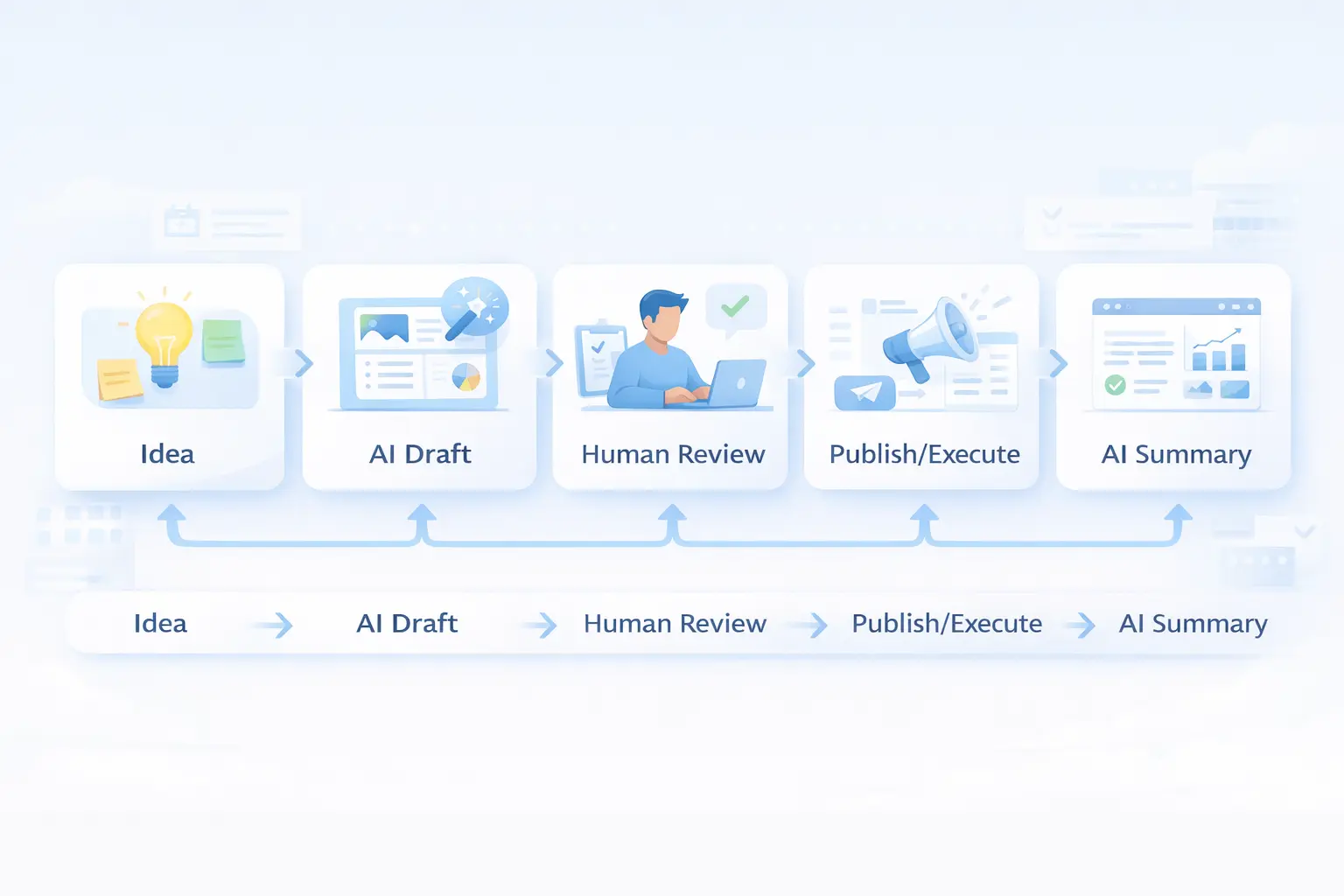
The best lean teams do not just sprinkle AI on random tasks. They redesign workflows.
Marketing workflow
A strong marketing workflow might look like this:
BizClearAI creates campaign angles, a writing tool drafts content, a scheduler publishes it, and a reporting tool summarizes results. The marketing lead reviews brand voice, approves creative, and decides what to scale.
Sales workflow
AI can help organize leads, suggest priorities, draft outreach, and remind the team when to follow up. Humans still handle trust, objections, and closing.
Operations workflow
AI can move information between tools, trigger reminders, update status fields, and generate weekly summaries so project management takes less manual effort.
Admin and customer support workflow
AI can answer repetitive questions, prepare draft responses, summarize customer tickets, and organize incoming requests. That keeps support responsive without requiring a large headcount.
If you want a practical rollout path, read The Step-by-Step Guide to Launching Your First AI Project for a Small Business. Lean team building works best when you implement one workflow at a time.
How to Roll Out a Lean AI Team Without Overcomplicating It
A lean team works best when implementation stays simple.
Phase 1: audit where time is being lost
Look at the work that drains the most hours each week. Usually this is admin, coordination, reporting, repetitive customer communication, or content production.
Phase 2: choose one workflow to improve
Do not overhaul the entire business at once. Pick one system with clear repetition and visible friction.
Phase 3: assign ownership
Choose who owns the workflow, which tool supports it, and where human review happens.
Phase 4: standardize prompts and process
Create a repeatable way of using the AI tool so results are consistent across the team.
Phase 5: measure the result
Track time saved, turnaround speed, consistency, and whether the workflow still needs manual intervention.
That step-by-step approach keeps AI useful instead of chaotic.
Measure AI Team Small Business Efficiency
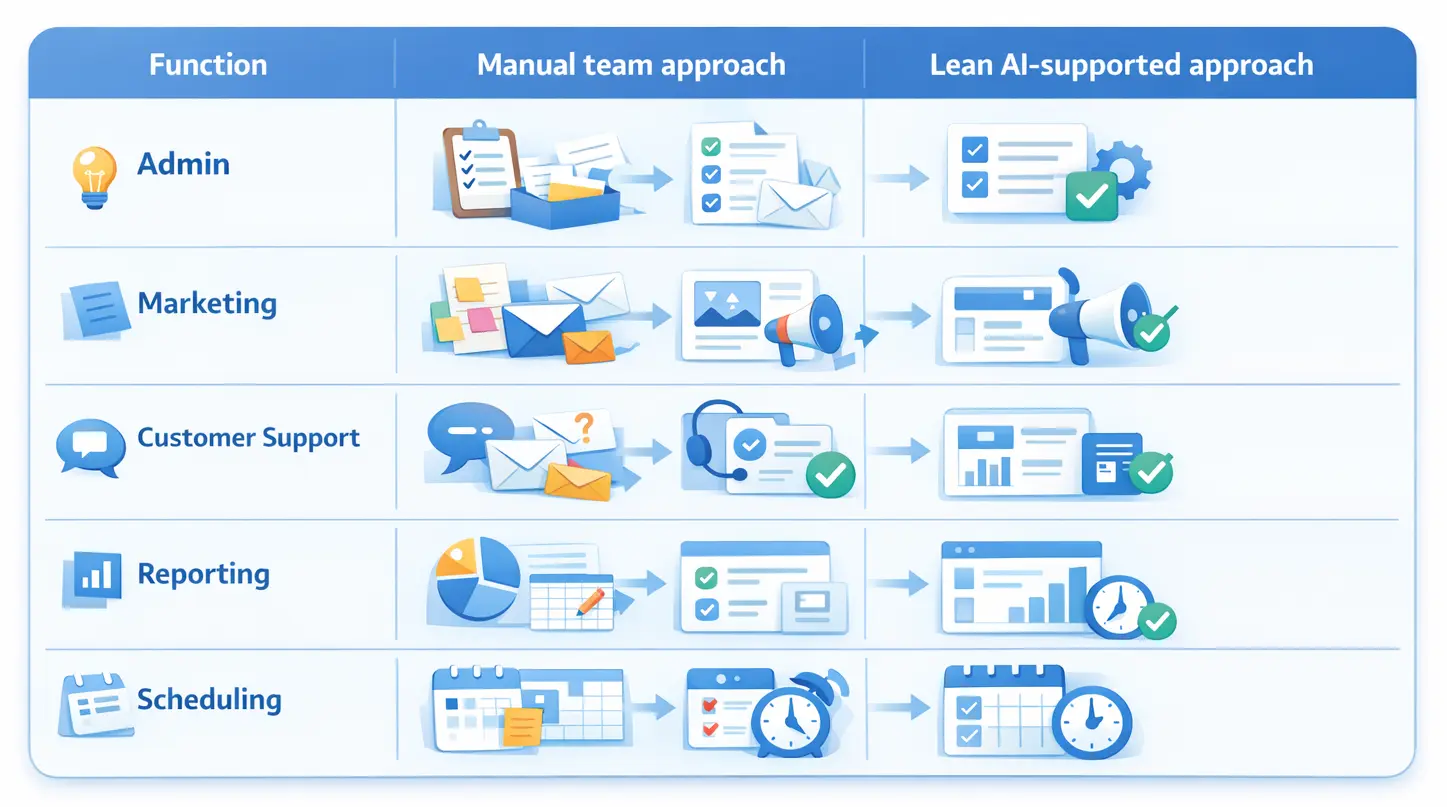
If you want your lean AI team to stay valuable, measure it.
You do not need complex analytics to start. You just need a few operating metrics that show whether your team is getting more done with less friction.
What to track
Focus on metrics such as:
hours saved per week
response time
campaign output
project turnaround time
number of manual handoffs
error reduction
hiring delayed or avoided because systems improved
A simple efficiency formula
A useful small-business calculation is:
Net Monthly Efficiency Value = (Hours Saved x Hourly Value x 4) - Monthly AI Cost
That gives you a practical way to compare the cost of the tool against the value of time reclaimed.
A simple example
If AI helps your team save 20 hours per month, and that time is worth $35 per hour, the value is $700. If the tools cost $120 per month, the net monthly value is $580.
That does not even include secondary gains like faster customer response, fewer mistakes, or more consistent output.
This is why AI team small business efficiency is not just about cost-cutting. It is about building a business where every hour produces more value.
Build a Culture That Uses AI Well
The tools matter, but team behavior matters just as much.
If AI feels confusing or optional, adoption will stay low. If it becomes part of the team’s normal way of working, efficiency builds faster.
A few simple habits help:
review one useful AI workflow in team meetings
share wins when someone saves time or improves output
document prompts and best practices
keep humans responsible for quality and decisions
A strong internal question to ask every month is:
What is one process we improved with AI this month?
That keeps the conversation focused on business improvement, not just software.
Final Thoughts: Small Team, Smarter System
The future of small business is not about hiring the biggest team first. It is about building the smartest operating model.
A lean AI-powered team gives you the ability to stay agile, protect margins, and scale without adding unnecessary overhead. Humans still lead. Humans still decide. Humans still build trust. But AI makes that team more efficient by handling the repetitive workload that slows growth down.
That is the real advantage.
If you want to build a business that works smarter, faster, and more profitably, start by designing systems before adding headcount. Explore BizClearAI, use the Prompt Library, and build one high-value workflow at a time.
FAQ: Lean AI-Powered Teams for Small Business
What is a lean AI-powered business team?
A lean AI-powered business team is a small team where people focus on strategy, relationships, and judgment while AI supports repetitive work like drafting, summarizing, organizing, and automation.
How does AI improve small business team efficiency?
AI improves efficiency by reducing manual tasks, speeding up workflows, improving consistency, and helping small teams produce more output without adding as much overhead.
Should small businesses automate before hiring?
In many cases, yes. If a task is repetitive, predictable, and time-consuming, it often makes sense to automate or streamline it before adding payroll.
What roles should stay human-first in an AI-powered team?
Leadership, creative direction, relationship-building, negotiation, and strategic decision-making should remain human-first because they require judgment and trust.
What is the best way to start building a lean AI team?
Start with one workflow that wastes time every week, assign one person to own the process, use AI to support that workflow, and measure the result over 30 days.
Share this post
Get Your Actionable Strategy Now
Join the many entrepreneurs using BizClearAI to scale faster and smarter.
No credit card required • Get 70 credits free every month