

How Small Businesses Can Boost Profit Margins Using Smart AI Systems
Apr 2, 2026
7 min read
Want a Custom AI Consultation?
Experience how BizClearAI can transform your business with immediate, actionable insights and AI-powered consulting.
Why Profit Margins Matter More Than Ever
Every small business owner eventually learns one hard truth:
Revenue looks good—but profit is what actually keeps your business alive.
You can increase sales, run more ads, or bring in more customers—but if your costs rise alongside your revenue, your business doesn’t actually become more sustainable.
Right now, small businesses are under more pressure than ever:
Costs are rising across the board
Competition is increasing in almost every industry
Customer attention is harder (and more expensive) to capture
That’s why improving your profit margin isn’t just a financial tactic—it’s your most powerful growth strategy.
And the best part?
You don’t need to work longer hours or take bigger risks. You simply need better systems—smarter ones.
👉 Start here: BizClearAI
What “Smart AI Systems” Really Mean for Small Businesses
When we talk about “smart AI systems,” we’re not talking about complex software or something only large corporations can use.
Instead, we’re talking about practical systems that quietly improve your business behind the scenes.
These systems:
Reduce wasted time and manual effort
AI takes over repetitive, low-value tasks that usually consume hours each week, allowing you and your team to focus on work that actually drives revenue and growth.Identify hidden costs you may not notice
Many businesses lose money in small, unnoticed ways—like inefficient processes or overlapping expenses—and AI helps uncover those gaps clearly.Improve decision-making with real data
Instead of guessing what might work, AI provides insights based on patterns, trends, and past performance, helping you make smarter business decisions.Continuously optimize operations without constant input
Once implemented, AI systems don’t just run once—they continuously analyze and improve workflows over time.
Think of AI as a quiet partner that’s always looking for ways to make your business more profitable.
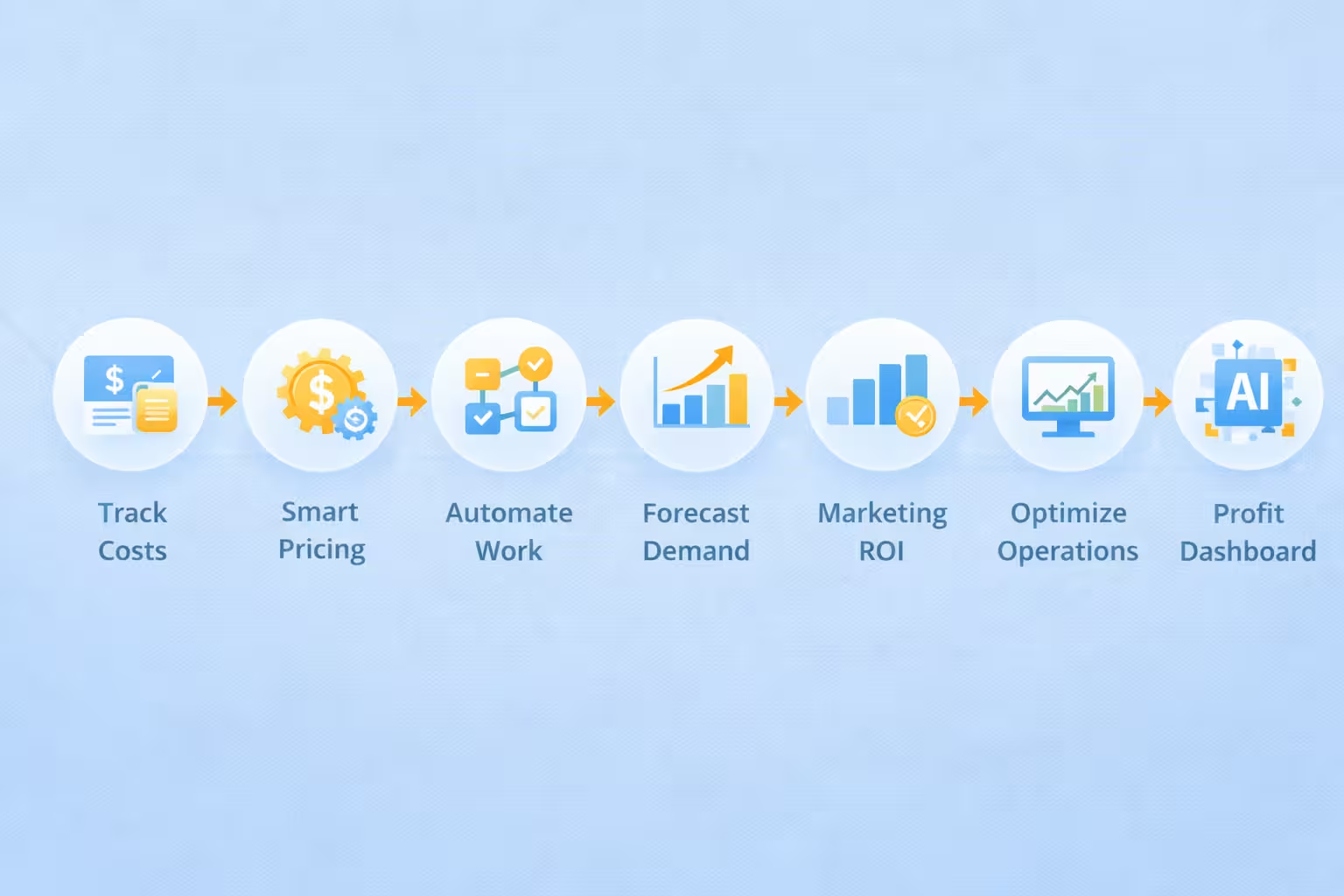
Step 1: Track and Analyze Your True Costs
You cannot improve what you don’t fully understand.
Most small business owners believe they know their costs—but in reality, many expenses are hidden in daily operations.
Key Cost Areas to Analyze
Cost Area | What’s Really Happening | Why It Hurts Profit |
Labor | Employees spend time on repetitive admin tasks instead of revenue-generating work | You’re paying for time that doesn’t grow the business |
Marketing | Budget is spread across multiple efforts without clear performance tracking | Money is spent without measurable return |
Tools | Multiple subscriptions overlap in functionality | You’re paying twice for the same outcome |
Inventory | Overstocking or slow-moving items tie up cash | Capital sits unused instead of generating profit |
What This Looks Like in Real Life
A business may spend hours each week on manual reporting when that process could be automated.
Marketing campaigns may continue running even if they’re not producing results.
Software subscriptions often accumulate over time, creating unnecessary monthly costs.
These inefficiencies don’t feel large individually—but together, they quietly reduce your profit margin.
👉 Learn how to uncover these hidden gaps: The Hidden ROI of Using AI in Your Small Business
Step 2: Optimize Pricing with Data, Not Guesswork
Pricing is one of the fastest ways to improve your profit margin—but it’s often handled incorrectly.
Most small businesses rely on instinct or competitor pricing, which can leave money on the table.
What Smart Pricing Actually Means
Understanding customer sensitivity to price changes
AI helps you determine how much you can increase or adjust pricing without losing customers, allowing you to maximize revenue per sale.Identifying high-demand products or services
Some offerings naturally perform better, and pricing them strategically can significantly increase your margins.Reducing unnecessary discounts
Many businesses discount too often, which reduces profit without increasing long-term value.
Why This Matters
Even a small improvement in pricing strategy can:
Increase revenue without increasing sales volume
Improve margins instantly
Strengthen perceived value
Step 3: Reduce Labor Costs Without Cutting Staff
Labor is often the largest expense—but reducing staff isn’t always the right answer.
Instead, the goal is to increase productivity per employee.
Where Time Is Usually Lost
Task Type | What Happens Now | Better Approach |
Admin tasks | Employees manually input and organize data | Automate repetitive workflows |
Communication | Staff respond to routine inquiries repeatedly | Use structured response systems |
Reporting | Hours spent compiling reports manually | Generate insights automatically |
Why This Matters
Employees spend more time on meaningful work
Output increases without increasing headcount
Costs stay stable while productivity rises
👉 Learn how to build efficient teams: How to Build a Lean AI-Powered Small Business Team
Step 4: Predict Demand and Avoid Costly Mistakes
One of the biggest threats to profit margins is poor planning.
Businesses often:
Order too much inventory
Miss peak demand opportunities
Tie up cash unnecessarily
How Better Forecasting Helps
Anticipating seasonal trends
Understanding when demand increases or decreases allows you to prepare in advance.Reducing waste from overproduction or over-ordering
Buying only what you need prevents excess inventory from sitting unused.Improving cash flow management
Predictable demand allows you to allocate resources more effectively.
The Result
Less waste
Better planning
More consistent profitability
Step 5: Improve Marketing ROI
Marketing should be an investment—not a gamble.
But many businesses overspend because they don’t know what’s working.
What Needs to Change
Identify which channels actually convert
Not all marketing efforts produce results, and focusing on the right channels increases efficiency.Stop spending on underperforming campaigns
Continuing ineffective campaigns drains resources without return.Improve targeting and messaging
Better alignment with customer needs leads to higher conversion rates.
Why This Matters
Lower cost per lead
Higher conversion rates
Better overall return on investment
👉 Learn more: Why AI Automation Matters for Small Businesses
Step 6: Continuously Optimize Operations
Profit improvement isn’t a one-time fix—it’s an ongoing process.
What Continuous Optimization Looks Like
Refining workflows regularly
Small improvements in processes can lead to significant long-term gains.Eliminating bottlenecks in operations
Identifying where delays happen allows you to streamline execution.Improving efficiency across teams
Better coordination reduces wasted effort and time.
Long-Term Impact
Over time, these small improvements compound into:
Higher efficiency
Lower costs
Stronger margins
Step 7: Build an AI Profit Dashboard
Tracking your progress is essential.
Without visibility, you can’t measure improvement.
What to Track
Revenue vs. costs
Understanding how money flows through your business is the foundation of profitability.Efficiency gains (time saved)
Tracking how much time is saved helps measure operational improvements.Margin improvement over time
Seeing trends allows you to adjust strategies effectively.
👉 Build your system: Prompt Library
Step 8: Build a Long-Term AI Strategy
The biggest mistake businesses make is stopping too early.
True transformation happens when everything works together.
What a Complete System Looks Like
Connected workflows
Each part of your business supports the next, creating seamless operations.Consistent optimization
Systems improve over time without constant manual intervention.Scalable growth
As your business grows, your systems grow with you.
Real Case Study: AI-Powered Profit Growth
Landscaping Business
Before:
Inefficient scheduling caused wasted time
Staff hours didn’t match demand
Profit margin was 20%
After improvements:
Scheduling aligned with demand
Operations streamlined
Profit margin increased to 34%
Restaurant (Full 8-Step Application)
Step 1: Identified waste in food and labor
Step 2: Adjusted pricing on high-margin items
Step 3: Improved staff scheduling efficiency
Step 4: Forecasted busy vs slow periods
Step 5: Focused marketing on top-performing offers
Step 6: Streamlined kitchen and service workflows
Step 7: Tracked performance daily
Step 8: Built long-term optimization strategy
Result: Profit margins doubled from 15% to 30%
Bringing It All Together
Profit Margin = (Revenue – Costs) ÷ Revenue × 100
AI improves this by:
Reducing costs
Increasing efficiency
Improving decisions
How BizClearAI Can Help
BizClearAI acts as your:
Profit analyst
Strategy advisor
Optimization system
👉 Start here: BizClearAI
👉 Related reading:
Conclusion: Smarter Systems, Stronger Margins
The future of small business success isn’t about doing more.
It’s about doing smarter.
And when you combine the right systems, the right strategy, and the right tools—you don’t just grow.
You become consistently profitable.
Share this post
Get Your Actionable Strategy Now
Join the many entrepreneurs using BizClearAI to scale faster and smarter.
No credit card required • Get 70 credits free every month